BUYING DECISION / BEST PORTABLE POWER STATIONS / 1kWh–1,000Wh CLASS
Best Portable Power Stations: BLUETTI vs EcoFlow vs Anker
Best 1kWh Portable Power Stations Compared
The three stations that occupy the 1 kWh class — the size most buyers actually end up with — judged against the same four buying questions. Same nominal capacity; they disagree about output, solar headroom, weight and whether you can ever add a battery.
The verdict at a glance
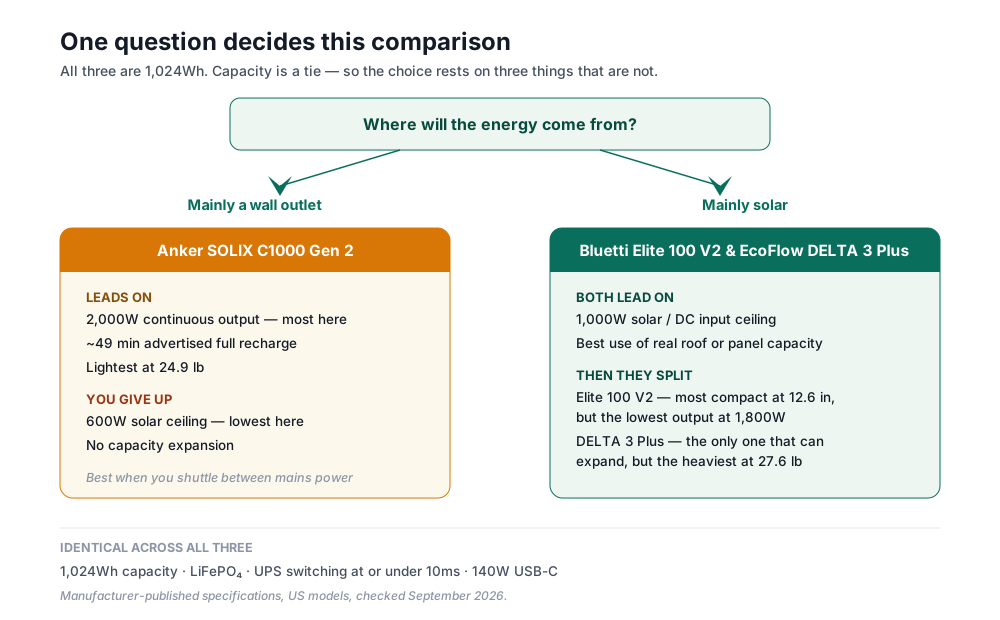
There is no single winner here, because the three stations are not optimised for the same buyer. The fastest way to choose is to answer one question first: where will the energy come from?
CHOOSE ONE
Three stations, three different reasons — which one fits you?
IF YOU RECHARGE FROM A WALL OUTLET
Anker SOLIX C1000 Gen 2
The highest continuous output of the three at 2,000W and the fastest advertised wall recharge at roughly 49 minutes. It is also the lightest at 24.9 lb. The trade is a 600W solar ceiling and no capacity expansion.
2,000W AC1,600W UltraFast
- Mains power is how you refill it
- You run power tools or other high-draw loads
- You want the lightest of the three
IF YOU MAY ADD A BATTERY LATER
EcoFlow DELTA 3 Plus
The only one of the three that can expand, which changes the question from “is 1,024Wh enough?” to “is 1,024Wh enough today?” It also accepts 1,000W of solar input.
Expandable1,000W solar
- You want capacity you can grow rather than replace
- Solar is one of your recharge routes
- You can accept the heaviest unit here at 27.6 lb
IF SOLAR AND PACK SIZE DECIDE IT
BLUETTI Elite 100 V2
A 1,000W solar ceiling in the most compact enclosure here at about 12.6 inches long. Rated output is the lowest of the three at 1,800W.
1,000W solarCompact footprint
- Solar is your main source
- Storage space is tight
- You are carrying it rather than rolling it
All three publish 1,024 Wh and LiFePO4 chemistry, so capacity and chemistry are ties. The fork above is the whole decision. Affiliate links · price and bundle may change.
Read the full C1000 Gen 2 review, then compare →Compare the two 1,000W-solar unitsRead the DELTA 3 Plus review
All three, side by side
| Specification | Elite 100 V2 | DELTA 3 Plus | C1000 Gen 2 |
|---|---|---|---|
| Battery capacity | 1,024Wh | 1,024Wh | 1,024Wh |
| Battery chemistry | LiFePO₄ | LiFePO₄ | LFP / LiFePO₄ |
| Rated AC output | 1,800W | 1,800W | 2,000W |
| Peak / boost output | Power Lifting mode | Surge support | 3,000W peak |
| Max AC charging | 1,200W | 1,800W | 1,600W UltraFast |
| Advertised AC recharge | 80% in ~45 min | ~80% in 50 min | 100% in ~49 min* |
| Max solar / DC input | 1,000W | 1,000W | 600W |
| UPS switching | ≤10ms | ≤10ms | 10ms |
| Cycle life | 4,000+ to 80% | 4,000+ to 80% | 4,000 to 80%+ |
| USB-C output | 140W + 100W | 140W + 100W | Up to 140W |
| Weight | 25.3 lb | 27.6 lb | 24.9 lb |
| Dimensions (in) | 12.6 × 8.5 × 9.8 | 15.4 × 9.6 × 10.2 | 15.12 × 8.19 × 9.61 |
| Expandable capacity | No | Yes (expansion battery) | No |
* Under Anker’s stated UltraFast charging conditions. Advertised recharge times are manufacturer claims under the stated charging conditions.
Output: Anker leads, but check your actual load
All three have 1,024Wh nominal storage. Anker rates 2,000W continuous AC output; Elite 100 V2 and DELTA 3 Plus rate 1,800W. The extra inverter headroom helps only when the simultaneous compatible load needs it. Capacity remains the runtime constraint.
Charging: fast on the wall, fast on the roof — pick one
Anker favors a short mains recharge window; BLUETTI and EcoFlow both list 1,000W solar input against Anker’s 600W. Compare exact charging modes and charge windows rather than treating partial and full-charge headlines as the same test.
For off-grid trips, match the panels’ electrical limits and realistic daily harvest to consumption. For trips with dependable outlets, solar ceiling may matter less than weight and AC turnaround.
Portability: weight and shape are different problems
Anker is listed at 24.9 lb, Elite 100 V2 about 25.3 lb and DELTA 3 Plus about 27.6 lb. The first two are close in weight; footprint and storage clearance may decide the carry/storage trade. Include the complete panel and cable kit.
Expansion: only one of the three can grow
DELTA 3 Plus has the documented route to additional battery storage. C1000 Gen 2 and Elite 100 V2 are fixed-capacity in these models. Choose expansion only when a concrete future budget warrants the added battery, weight and price; verify compatibility rather than buying from a maximum-system headline.
BLUETTI ELITE 100 V2
Compact solar headroom
Strengths: 1,000W solar input; the smallest footprint of the three; 140W + 100W USB-C; ≤10ms UPS.
Costs: lowest rated output at 1,800W; no capacity expansion; 1,024Wh stays 1,024Wh.
ECOFLOW DELTA 3 PLUS
The expandable one
Strengths: 1,000W solar input, up to 1,800W AC charging and the only expandable battery of the three.
Costs: heaviest at about 27.6 lb, which works against the portability the class is known for.
ANKER SOLIX C1000 GEN 2
Output and wall speed
Strengths: 2,000W continuous output, 1,600W UltraFast charging and the lightest build at 24.9 lb.
Costs: 600W solar ceiling — the lowest here — and no capacity expansion at all.
THE PATTERN
Each brand bets on one thing
Anker bets on output and mains speed. BLUETTI bets on solar headroom and size. EcoFlow bets on expansion. None of them bet on capacity, because capacity is identical.
Final verdict
Choose Anker for output headroom and a mains-focused routine, Elite 100 V2 for compact storage and compatible solar headroom, or DELTA 3 Plus for documented battery expansion. All three begin at 1,024Wh; fit the recharge interval and complete-kit cost before checking prices.
Because all three are so close on capacity and cycle life, price should carry real weight in this decision. A promotion on any one of them can outweigh a specification difference you may never actually use.
STILL DECIDING?
Take one pairing at a time
The three-way view is for elimination. Use the two-way pages to make the final call.
- Elite 100 V2 vs DELTA 3 Plus →
- C1000 Gen 2 vs Explorer 1000 v2 →
- DELTA 3 Plus vs C1000 Gen 2 →
- Elite 100 V2 vs C1000 Gen 2 →
Or step up a class
None of these three fits because your loads are whole-home rather than camping?
- Apex 300 vs F3800: the 240V home-backup decision →
- Or start from whether you need the extra capacity at all →
Coming from a mid-size station?
Sources & editorial method
Sources & methodology
Research checked September 24, 2026. This page covers the US versions of all three models. Specifications come from official manufacturer documentation; every estimate is labelled as such. Advertised recharge times are manufacturer claims under stated ideal conditions and are not guaranteed results.
- BLUETTI Elite 100 V2 US product page ↗ — capacity, output, solar input, ports and weight.
- EcoFlow DELTA 3 Plus product page ↗ — capacity, output, AC charging, expansion battery support and weight.
Live offers and bundle contents should be checked at the retailer.