CAMPING / 1KWH · US MODEL · UPDATED SEPTEMBER 30, 2026
Jackery Explorer 1000 v2 Review: A Lightweight 1kWh Camping Option
Affiliate disclosure: We may earn a commission when you buy through these links, at no additional cost to you. How our links work.
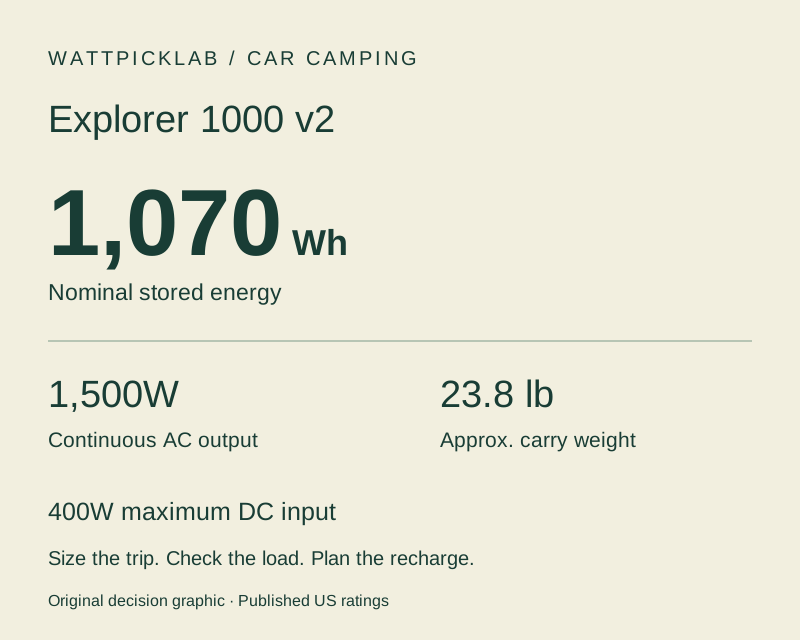
Choose the Explorer 1000 v2 if you want roughly 1kWh for car camping and would rather carry less weight than buy extra inverter headroom. Its 23.8 lb specification is the attraction; the 1,500W output and 400W solar ceiling are the limits to check first.
QUICK VERDICT
Less weight. Enough power for a planned trip.
A useful lightweight 1kWh camping option when portability comes before high-wattage cooking.
Affiliate disclosure: WattPickLab may earn a commission at no extra cost to you.
Buy it if
- You move the station between a vehicle and a nearby campsite.
- Your simultaneous AC loads fit comfortably below 1,500W.
- You can recharge between trips or have a modest, realistic daily energy budget.
Consider another option if
- You regularly use high-power cooking appliances near or above 1,500W.
- You want to add a matching expansion battery later.
- Your off-grid plan depends on harvesting well above 400W of solar input.
The numbers that change the decision
The 1,070Wh label is only about 4.5% above a 1,024Wh battery. That small difference should not outweigh a better match in output, recharge capability or carrying comfort.
1. Start with your campsite energy budget
List the devices, average consumption and time between reliable recharges. With an illustrative overall 80% usable-energy factor and 10% reserve, 1070Wh gives about 770Wh for planned loads. At 700Wh per day, that is about 1.1 days. These are assumptions, not measured usable capacity.
Use measured daily consumption for cycling appliances and include every load. Do not deduct a second conversion allowance from this already derated budget. A bigger battery extends the interval before recharging; it does not establish appliance compatibility.
Illustrative calculation: 1,070Wh × 0.80 usable factor ÷ daily load. No recharge. Actual delivery varies; these are estimates, not measured runtimes.
Calculate your own energy budget → · Build a campsite load list →
2. Check continuous output before appliance names
The 1,500W continuous AC rating applies to the combined load, not to each socket separately. Check startup demands and the exact outlets. Heating appliances consume substantial energy even when their wattage fits; a compatible kettle can still use a large share of the daily budget.
3. The 400W solar ceiling is the key trade-off
The 400W combined solar/DC input ceiling is shared by these Explorer v2 models. Check the exact compatible panels, voltage and cables. A higher-capacity battery with the same solar ceiling takes more harvest time to refill.
A 400W array producing its nameplate output for three equivalent full-sun hours would provide 1,200Wh before derating. Weather, shading and orientation reduce this hypothetical yield. Plan AC recharge opportunities where available rather than counting ordinary daylight as full-output hours.
4. Portability and the cost of the complete setup
At 23.8 lb, plan the lift you will repeat between vehicle, storage and campsite. This is a fixed-capacity station, so future expansion requires a different purchase rather than a matching add-on battery.
Compare the complete kit: station, panel quantity, cables, delivery, warranty and return terms. A Solar Generator bundle adds specified equipment; it does not change the station’s battery capacity. Verify the exact Explorer 1000 v2 rather than a similarly named Plus or Pro model.
What to compare before deciding
More cooking headroom
Compare Anker SOLIX C1000 Gen 2 if a 1,500W limit is too restrictive. Capacity alone will not resolve an output mismatch.
Compare Explorer 1000 v2 with the C1000 Gen 2 → Read the existing C1000 Gen 2 comparison →Solar and expansion priorities
Consider DELTA 3 Plus when a supported expansion battery or a larger solar input ceiling is central to your plan.
Read the DELTA 3 Plus review →More stored energy
The Explorer 2000 v2 steps up to 2,042Wh, at 39.5 lb. Choose it for a larger energy budget, with the same 400W solar constraint.
Read the Explorer 2000 v2 review →Compare published specifications side by side → · See the camping shortlist →
The final decision
YOUR PRIORITY → YOUR NEXT STEP
Lower carry weight + a planned load budget
The Explorer 1000 v2 earns its place as a lightweight 1kWh camping option. Buy it for that balance if 1,500W and 400W solar fit your use. Choose another model when cooking output, expansion or solar recovery matters more.
Questions before buying
Does the Explorer 1000 v2 support expansion batteries?
No. Treat this as a fixed-capacity station. Check a documented expandable platform if future battery growth is a priority.
Sources & how we evaluate
WattPickLab evaluates products using manufacturer specifications, technical documentation, ownership costs and use-case analysis. Specifications below were checked on September 30, 2026 for US models. We label calculations and separate them from manufacturer ratings; the diagrams are original WattPickLab illustrations of published ratings.
This review uses manufacturer documentation and product specifications. Runtime examples use nominal capacity × 0.80 ÷ load; the 0.80 factor is an illustrative usable-energy assumption. Performance varies with load, settings and operating conditions.