COMPARISON / 1kWh CLASS / US MODELS
Anker SOLIX C1000 Gen 2 vs Jackery Explorer 1000 v2: Which 1kWh Station Fits Your Trip?
Roughly the same stored energy, two different bets: Anker spends it on output, charging speed and a 600W solar ceiling. Jackery spends it on being a lighter carry and a simpler fixed-capacity station.
Affiliate disclosure: WattPick Lab may earn a commission from qualifying purchases through affiliate links, at no additional cost to you. Editorial conclusions are independent of commissions. How our links work.
30-SECOND ANSWER
Jackery for the lighter carry. Anker for everything the station has to do.
Both land in the same class at roughly 1kWh, so capacity will not settle this. The published numbers disagree in three places that change what you can run and how fast you can refill.
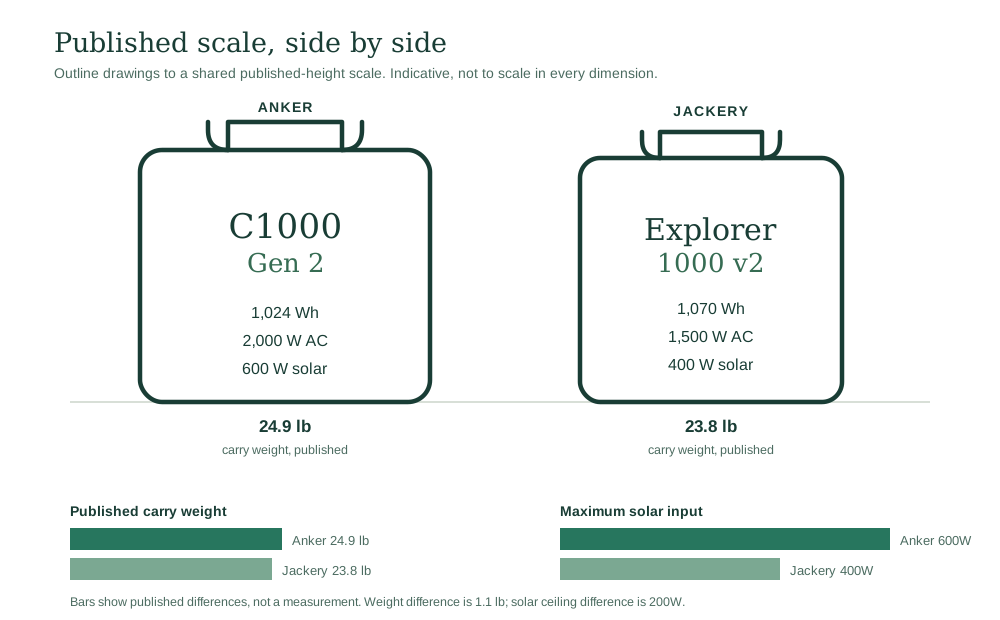
Pick the Explorer 1000 v2 if the lift is the deciding factor. At 23.8 lb it is the lighter station here, and its 1,070Wh label is marginally higher. If your loads stay well under 1,500W and you charge from an outlet before you leave, its smaller numbers will rarely show up in daily use.
Pick the C1000 Gen 2 if output, recharge speed or solar recovery matter. It offers 2,000W continuous instead of 1,500W, a 600W solar ceiling instead of 400W, and up to 1,600W UltraFast AC charging — covering higher-draw appliances and short recharge windows the Jackery has to work around.
One-line rule: if you never exceed 1,500W and never rely on solar, take the lighter Jackery; the moment either changes, the Anker earns its extra 1.1 lb.
Live pricing
View Current C1000 Gen 2 Price View Current Explorer 1000 v2 Price Both are fixed-capacity stations with no expansion battery. Confirm the exact US model, bundle contents and delivery date at the retailer.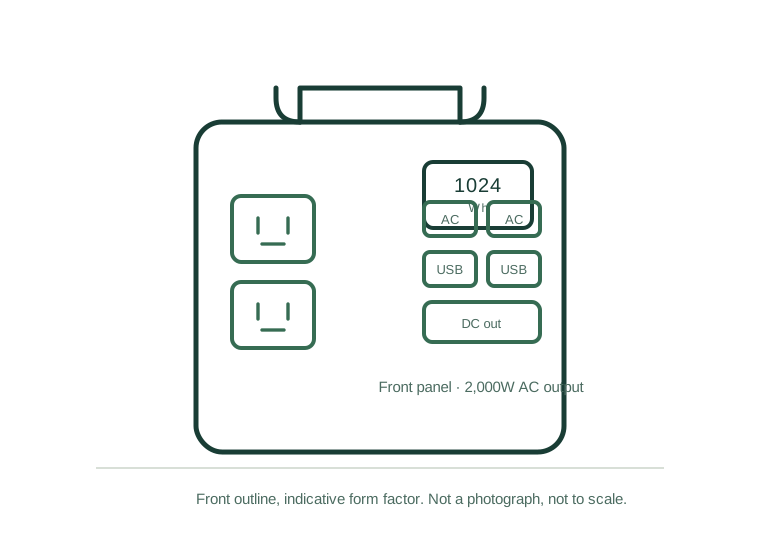
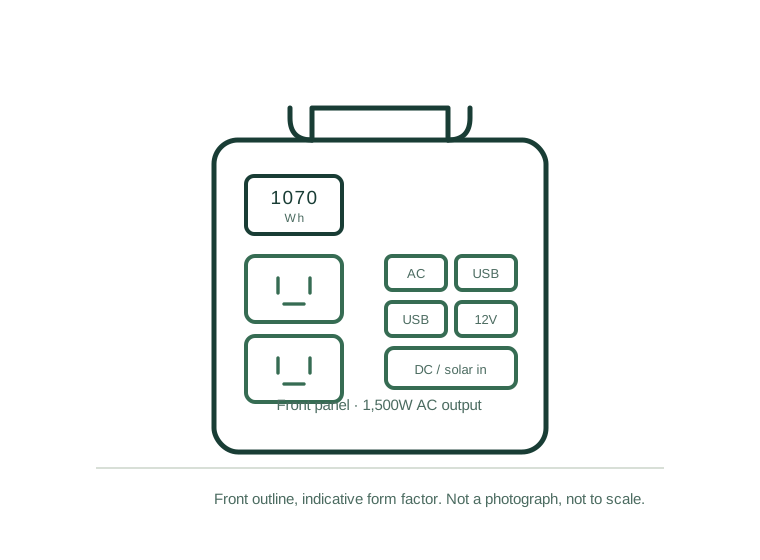
Side-by-side specifications
Published figures from Anker and Jackery. Where the difference is small, this page says so; where it changes what you can run, it gets its own section below.
| Specification | Anker SOLIX C1000 Gen 2 | Jackery Explorer 1000 v2 |
|---|---|---|
| Nominal capacity | 1,024Wh | 1,070Wh |
| Battery chemistry | LiFePO₄ (LFP) | LiFePO₄ (LFP) |
| Rated AC output | 2,000W | 1,500W |
| Peak / surge output | Up to 3,000W peak | 3,000W advertised surge |
| Maximum AC charging | Up to 1,600W UltraFast | App-controlled charging modes |
| Advertised full AC charge | About 49 minutes (Anker claim) | Not published as a single figure |
| Maximum solar input | Up to 600W | Up to 400W |
| Weight | About 24.9 lb | About 23.8 lb |
| Dimensions | 15.12 × 8.19 × 9.61 in | Not itemised here |
| Battery expansion | Not supported | Not supported |
| Cycle life | 4,000 cycles to 80%+ (Anker claim) | 4,000 cycles to 70%+ (Jackery claim) |
Sources: View Current C1000 Gen 2 Price and View Current Explorer 1000 v2 Price . Cycle-life endpoints differ between the two claims and are not directly comparable.
1. AC output: 2,000W vs 1,500W
This is the difference most likely to change your appliance list. Anker rates the C1000 Gen 2 at 2,000W continuous; Jackery rates the Explorer 1000 v2 at 1,500W. Both publish a 3,000W peak or surge figure, but peak ratings are not a continuous allowance.
For phones, laptops, lights, a router, a TV or a CPAP, the two stations behave identically. The gap only appears near the top of the range: a microwave, kettle, hot plate, hair dryer or power tool can consume most of the Jackery’s 1,500W alone, and adding a second load puts you at its inverter limit. Read the input wattage on the label of the device you actually intend to run.
Runtime is a separate calculation from output: a 2,000W inverter does not make a ~1kWh battery last longer.
2. Recharging: a 49-minute mains claim vs an app-managed Jackery
Anker specifies up to 1,600W UltraFast AC charging and advertises a full recharge in as little as 49 minutes — Anker’s claim under its stated UltraFast conditions, with the mode enabled in the Anker app. It is not our measurement. Jackery offers app-controlled charging modes rather than one headline full-charge time, so the two are not directly comparable on paper.
What matters for buying is simpler: a 49-minute class recharge suits a trip with short access to grid power, and matters much less if the station sits charged in a closet waiting for an outage.
Solar recovery is the sharper split
The durable difference is the input ceiling. The C1000 Gen 2 accepts up to 600W of solar; the Explorer 1000 v2 tops out at 400W. A larger panel nameplate does not make the Jackery accept more — panel voltage, current, connectors and arrangement must match the manual.
Dividing 1,070Wh by 400W gives about 2.7 hours as a loss-free calculation, and 1,024Wh by 600W gives about 1.7 hours. Neither is a real full-charge time: sunlight changes, conversion costs energy and charging tapers. Treat the ceilings, not the arithmetic, as the buying signal. See our solar generator buying guide before pairing panels.
3. Portability: a 1.1 lb gap, and a real one
The Explorer 1000 v2 is listed at 23.8 lb; the C1000 Gen 2 at 24.9 lb. That 1.1 lb is the Jackery’s clearest advantage, and also the easiest to overstate.
Both are vehicle-to-campsite stations rather than backpacking batteries. Lifting the unit out of a car once a trip will not decide anything. If you carry it repeatedly — up stairs, across a site, between a van and a tent — the lighter station is genuinely easier to live with, and you should weigh the panels and cables in the same decision.
Capacity is the one place the Jackery leads on paper: 1,070Wh against 1,024Wh. That is roughly 4.5% and should not outweigh output, recharge or carrying comfort.
4. Expansion: neither station grows
This is the shared limitation, and it matters more than the numbers above because it fixes your decision now. Neither the C1000 Gen 2 nor the Explorer 1000 v2 supports an integrated expansion battery. Whatever you buy is the capacity you own.
That reframes the question. Do not ask “can I add a battery later?” — ask “is this the capacity class I want for the whole ownership period?” If you already expect to need substantially more energy, neither page should be your final stop: step up to a 2kWh station or an expandable platform instead.
CHOOSE ONE
Choose the C1000 Gen 2 if… or the Explorer 1000 v2 if…
ANKER
Anker SOLIX C1000 Gen 2
- Your appliance list crosses or approaches 1,500W
- You want the fastest mains recharge in this class, with a 49-minute claim
- You plan to harvest solar above 400W
- You would rather trade 1.1 lb for more output and headroom
JACKERY
Jackery Explorer 1000 v2
- You carry the station often and 23.8 lb matters more than output
- Your simultaneous loads stay comfortably below 1,500W
- You recharge from an outlet between trips, not from large solar
- You want the marginally higher 1,070Wh label in a simpler station
If neither column matches cleanly, the choice is probably not between these two. Prices for both are a click away above. Affiliate links · price and bundle may change.
FINAL DECISION
Jackery is lighter. Anker offers more output and charging headroom.
The choice comes down to which shortfall you can live with. If your loads are modest, charging happens at the outlet, and the lift is the part you would actually notice, the lighter Explorer 1000 v2 is the honest pick. If the station has to cover higher-draw appliances or a real solar setup, the C1000 Gen 2 is the one that keeps up.
Still deciding?
The split that settles most cases is output: 2,000W against 1,500W. If a third station is still on your list, compare it directly.
Other 1kWh pairings
Want one model in full?
Frequently asked questions
Which charges faster from a wall outlet?
Anker advertises about 49 minutes to full using its 1,600W UltraFast mode, enabled in the Anker app. Jackery offers app-controlled charging modes instead of one headline full-charge time. We have not measured either.
Which supports more solar input?
The Anker C1000 Gen 2, at up to 600W, against up to 400W for the Explorer 1000 v2. The ceiling matters only if you also have compatible panels and adequate sunlight.
Do either of these support an expansion battery?
No. Both are fixed-capacity stations. If future capacity growth matters, consider an expandable platform or a larger capacity class instead.
Did WattPick Lab test these stations?
No. This is a research-based comparison using manufacturer documentation and labelled calculations. We have not measured usable capacity, charging speed, noise or long-term reliability.
Sources & editorial method
Sources & methodology
Research checked September 30, 2026. This comparison covers the US versions of both models. We use official documentation for specifications and label every calculation as an estimate. Advertised recharge times are manufacturer claims under stated ideal conditions and are not guaranteed outdoor performance.
- View Current C1000 Gen 2 Price — capacity, 2,000W output, 1,600W UltraFast charging, 600W solar input, weight and the no-expansion limitation.
- View Current Explorer 1000 v2 Price — capacity, 1,500W output, 400W solar ceiling and 23.8 lb weight.
We have not published measured usable-energy, noise or reliability figures for either model. Merchant prices and customer ratings are not our test evidence; check live offers and bundle contents at the retailer. Cycle-life endpoints are manufacturer laboratory claims with different thresholds and are not directly comparable.