ANKER SOLIX / FOUR MODELS / 1kWh TO 240V
Which Anker SOLIX fits your setup?
Four SOLIX models, four different jobs. Each rung answers a question the one below it cannot — more output, more runtime, a larger reserve, or native 240V.
The four rungs at a glance
Read the tag, not the capacity — a bigger number is not automatically the right one.
Mainstream pick
Start hereAnker SOLIX C1000 Gen 2
1,024Wh · 2,000W · 24.9 lb
Camping, tailgating and short outages. The lightest way to run a fridge and real appliances.
More runtime
Anker SOLIX S2000
2,010Wh · 1,500W · 35.7 lb
Longer time away from an outlet. Twice the stored energy — but a lower output ceiling than the C1000 Gen 2.
Large and expandable
Anker SOLIX F3000
3,072Wh · 3,600W · 2,400W solar
A big reserve and high output in one box, with the solar headroom to refill it off-grid.
Home backup
Anker SOLIX F3800
3,840Wh · 6,000W · native 120V/240V
Whole-home circuits and 240V loads. 132.3 lb — this one lives where you install it.
Some links here are affiliate links: we may earn a commission on qualifying purchases at no extra cost to you, and it does not change which model we name. Every figure is a manufacturer specification, not a WattPickLab test result — we have not measured these units. How our links work.
Which SOLIX class fits you?
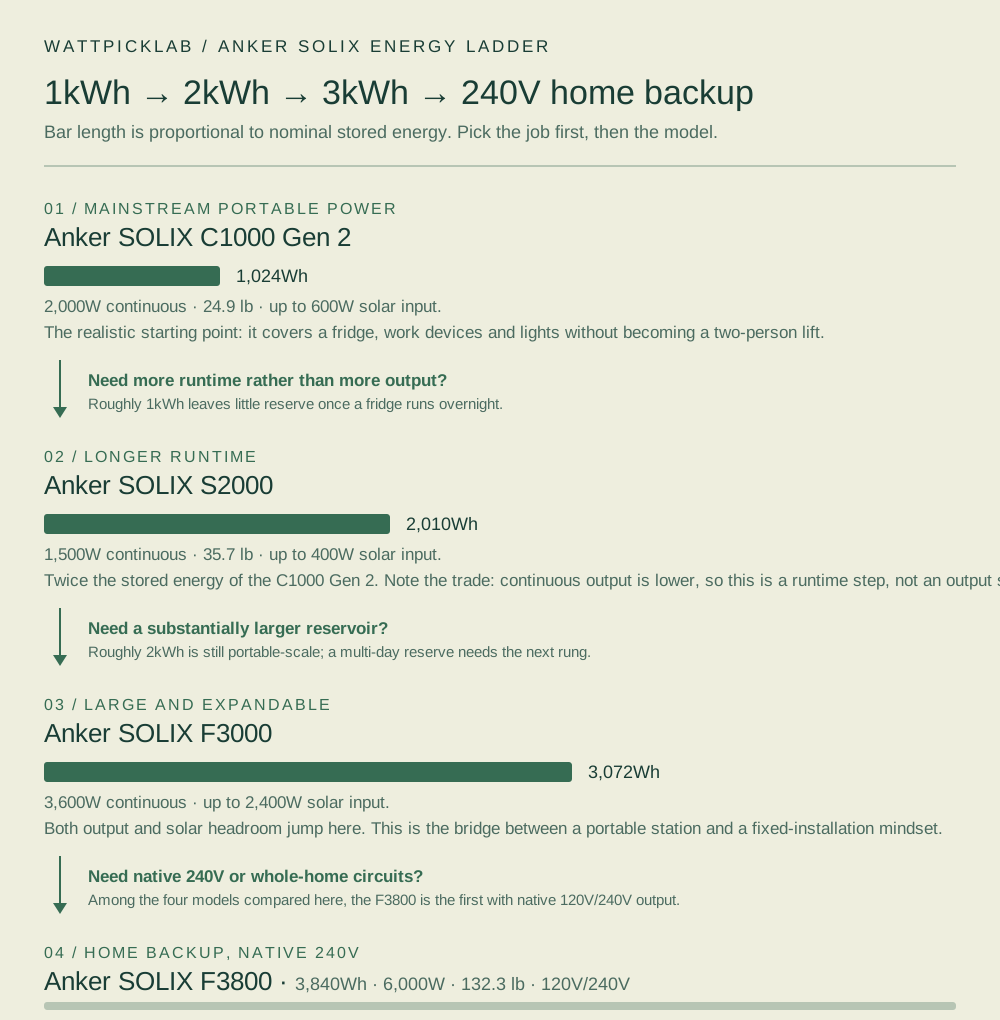
Anker’s SOLIX line is a ladder, and each rung exists because the one below it cannot do something. Bar length below is proportional to nominal stored energy — all manufacturer ratings.
01
Anker SOLIX C1000 Gen 2
Mainstream rung. 1,024Wh · 2,000W · 24.9 lb · 600W solar.
02
Anker SOLIX S2000
Runtime rung. 2,010Wh · 1,500W · 35.7 lb · 400W solar.
03
Anker SOLIX F3000
Reserve rung. 3,072Wh · 3,600W · up to 2,400W solar.
04
Anker SOLIX F3800
Home-backup rung. 3,840Wh · 6,000W · 132.3 lb · native 120V/240V.
Compare the four models
| Specification | C1000 Gen 2 | S2000 | F3000 | F3800 |
|---|---|---|---|---|
| Model | 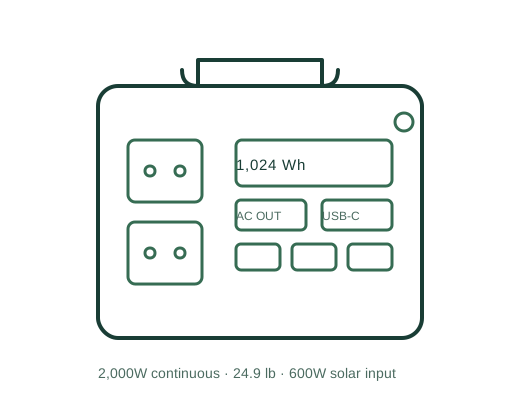 | 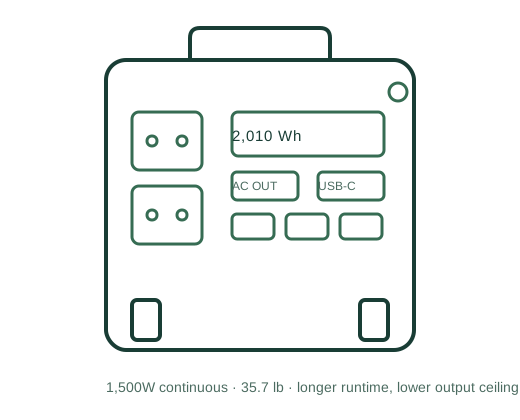 | 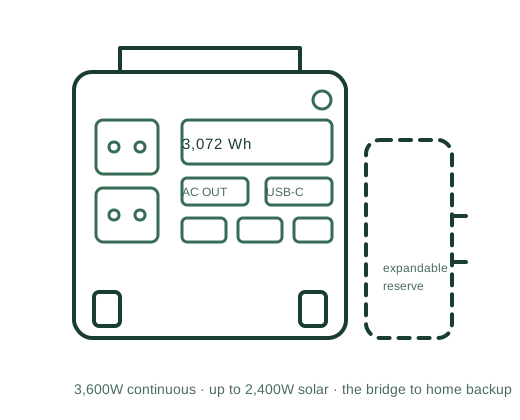 | 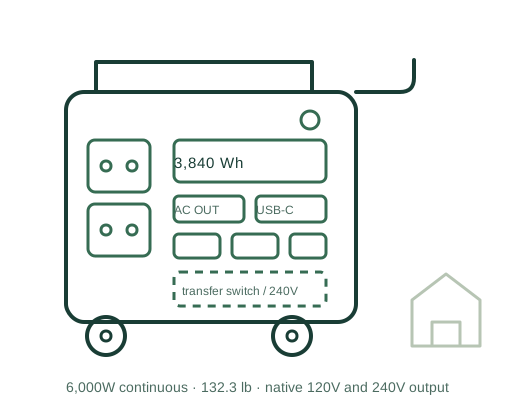 |
| Nominal capacity | 1,024Wh | 2,010Wh | 3,072Wh | 3,840Wh |
| Continuous AC output | 2,000W | 1,500W | 3,600W | 6,000W |
| Weight | 24.9 lb | 35.7 lb | Not published here | 132.3 lb |
| Max solar input | 600W | 400W | 2,400W | Not published here |
| Native 240V output | No | No | No | Yes |
| Best fit | Mainstream portable power | Longer runtime away from an outlet | A large expandable reserve | Whole-home and 240V backup |
| Main trade-off | Little reserve left at ~1kWh | Lower output ceiling than the C1000 Gen 2 | Still 120V, and heavy to move | 132.3 lb; needs a place to live |
| Price | View Current C1000 Gen 2 Price ↗ | View Current S2000 Price ↗ | View Current F3000 Price ↗ | View Current F3800 Price ↗ |
The four models in short
One question each: who it is for, why it is the answer, and when it is the wrong answer.
START HERE
Anker SOLIX C1000 Gen 2
Best for mainstream portable powerWhy choose it1,024Wh at 2,000W and 24.9 lb is an awkward gap done well: enough to run a compressor fridge and a laptop overnight, light enough to carry to the car without thinking about it. 600W of solar input is the highest in the portable end of the line.
Skip it ifRoughly 1kWh leaves very little slack. If a normal trip ends under 20%, or you want 2,000W for hours rather than minutes, go up a rung.
MORE RUNTIME
Anker SOLIX S2000
Best step up when runtime mattersWhy choose it2,010Wh roughly doubles the C1000 Gen 2’s stored energy for about 11 lb more. That is a different trip length rather than a different load list — the model for a long weekend off-grid, or a multi-day outage where you stop watching the percentage.
Skip it ifContinuous output is 1,500W, lower than the smaller C1000 Gen 2. If your constraint is a high-draw appliance rather than hours of runtime, this step moves you sideways. Go to the F3000 instead.
LARGE AND EXPANDABLE
Anker SOLIX F3000
The bridge between portable power and home backupWhy choose it3,072Wh at 3,600W, with up to 2,400W of solar input — four times the C1000 Gen 2’s recharge ceiling. This is where the page stops describing camping gear: the output clears most household appliances one at a time, and the reserve is large enough to plan an outage around.
Skip it ifIt has no native 240V output, so it is not a whole-home system. A 240V well pump, a dryer or a transfer switch feeding house circuits needs the F3800 — and no amount of capacity fixes that.
HOME BACKUP
Anker SOLIX F3800
Best fit for serious home backupWhy choose it3,840Wh, 6,000W output and native 120V/240V — the only model here that addresses 240V loads directly. It is the end of the ladder: above it, the conversation is a fixed installation.
Skip it if132.3 lb. If your real use is camping twice a year, you are buying a permanently parked appliance and carrying the weight of one. The F3000 covers the same trips for far less bulk.
Do you need to move up a rung?
Three steps, three different reasons. Getting the reason right matters more than getting the size right — a step taken for the wrong reason buys you weight and nothing else.
C1000 Gen 2 → S2000
Is roughly 1kWh of runtime the problem?
If a normal trip or outage leaves you under about 20% and you are managing the battery rather than using it, the extra 986Wh is the fix. If you keep hitting the output ceiling instead, this step lowers it.
S2000 → F3000
Do you need substantially more output, or a bigger reserve?
3,600W against 1,500W is the largest single output jump on this ladder, and four times the solar input changes what a day off-grid can refill.
F3000 → F3800
Do you need native 240V or whole-home circuits?
A change of category, not of size. Native 120V/240V is what lets the F3800 address well pumps, dryers and a transfer switch. If every load you own is 120V, the F3000 already covers it.
There is no price button in this section on purpose.
Keep researching
Going camping?
Sizing starts from trip energy and how you refill, not from capacity.
Camping guide →Shopping around 1kWh?
Not committed to Anker? The 1kWh head-to-head puts the C1000 Gen 2 against the BLUETTI and EcoFlow equivalents.
1kWh comparison →Building home backup?
Two routes to 240V: 6,000W in one box, or a system nearly 50 lb lighter you build around.
Apex 300 vs F3800 →Still deciding?
If your loads are everyday and you carry the station yourself, the C1000 Gen 2 is the rung. If something you need to power runs on 240V, only the F3800 answers it.
Frequently asked questions
Is the C1000 Gen 2 or the S2000 the better first Anker SOLIX?
The C1000 Gen 2 is the better first station for most readers: 1,024Wh at 2,000W and 24.9 lb covers a fridge, work devices and lights, and it is the lightest model here. Choose the S2000 instead when runtime rather than output is your constraint — it stores about 2,010Wh, but its continuous output is 1,500W against the C1000 Gen 2’s 2,000W.
How much Anker SOLIX capacity do I actually need?
Estimate the watt-hours your loads use between recharges, then add a reserve. Under about 1kWh suits small devices and short trips. Roughly 1kWh with output headroom suits a fridge plus work devices, which is where the C1000 Gen 2 sits. About 2kWh to 3kWh suits longer gaps between recharging or a larger reserve, which is the S2000 and F3000.
Which Anker SOLIX is best for camping?
For car camping and RV trips, the C1000 Gen 2 fits: 24.9 lb is a one-person carry, and 2,000W clears the appliances a campsite actually uses. Multi-night trips with a fridge and poor recharging favour the S2000’s 2,010Wh. At 132.3 lb the F3800 is not a camping product.
Do I need the F3800 for home backup?
Only if some of what you need to power is 240V, or you are feeding house circuits through a transfer switch. That is what native 120V/240V output buys. If every load you need is a 120V appliance, the F3000 already covers it.
How we compare Anker SOLIX power stations
This page is a model decision, not a product test. We compare only manufacturer-published specifications for US models — nominal capacity, continuous output, weight, solar input ceiling and native voltage — and label every derived figure as an estimate. We have not measured usable energy, runtime, noise or reliability for any of these units.
The SOLIX line was checked against Anker’s US product pages on September 30, 2026. Every model on this page has a retailer link; which models carry a price button does not affect their place in the ladder, which reflects published specifications only. The F3800 review carries the full verification record for that model.
Anker US specifications checked September 30, 2026: Anker SOLIX C1000 Gen 2 · Anker SOLIX S2000 · Anker SOLIX F3000 · Anker SOLIX F3800.