Best Portable Power Stations: Top Picks by Use Case
Affiliate disclosure: We may earn a commission when you buy through these links, at no additional cost to you. How our links work.
Quick Verdict
Start with the BLUETTI Elite 100 V2 for a balanced 1kWh option. Choose the DELTA 3 Plus for camping flexibility, Jackery for lighter carrying or fixed 2kWh capacity, and the F3800 only when your home-backup plan needs its larger system capabilities.
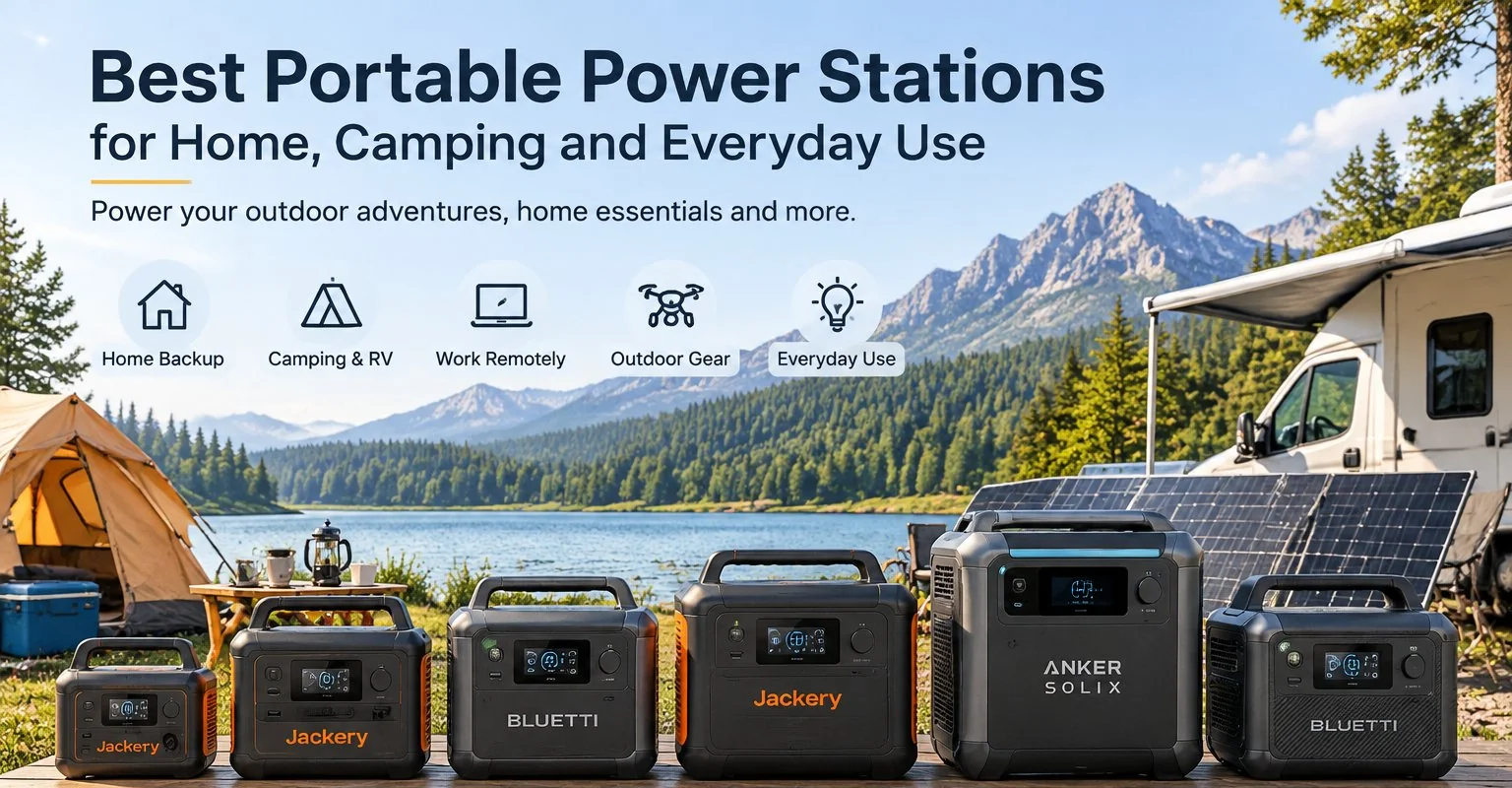
Product appearance and bundle contents can change.
Top Picks
Choose the role that matches your main job, then check its main compromise. Check the current price or read the detailed recommendation and review.
BLUETTI Elite 100 V2
A balanced 1kWh starting point for mixed use. Choose it for regular carrying and modest outage essentials; skip it when you already expect to add an expansion battery.
EcoFlow DELTA 3 Plus
The flexible camping pick when recharging and future expansion matter. Its extra weight over the lighter 1kWh options buys flexibility, rather than more energy in the base battery.
Jackery Explorer 1000 v2
For buyers who want roughly 1kWh with an easier lift. Its lower continuous output is the tradeoff: check the appliances you will run together before choosing on weight.
Jackery Explorer 2000 v2
More stored energy for longer trips or selected home essentials, at about 39.5 lb. Choose it when your load budget exceeds 1kWh; it is still a fixed-capacity 120V station.
Anker SOLIX F3800
For a planned home system with 120V/240V requirements and room to expand. This is a heavy wheeled unit; include batteries, connection equipment and installation in the budget.
Jackery Explorer 300
The smallest commitment for phones, cameras, lights and other low-power loads. This is the original Explorer 300, not the 300 Plus; prioritize easy carrying over long runtime.
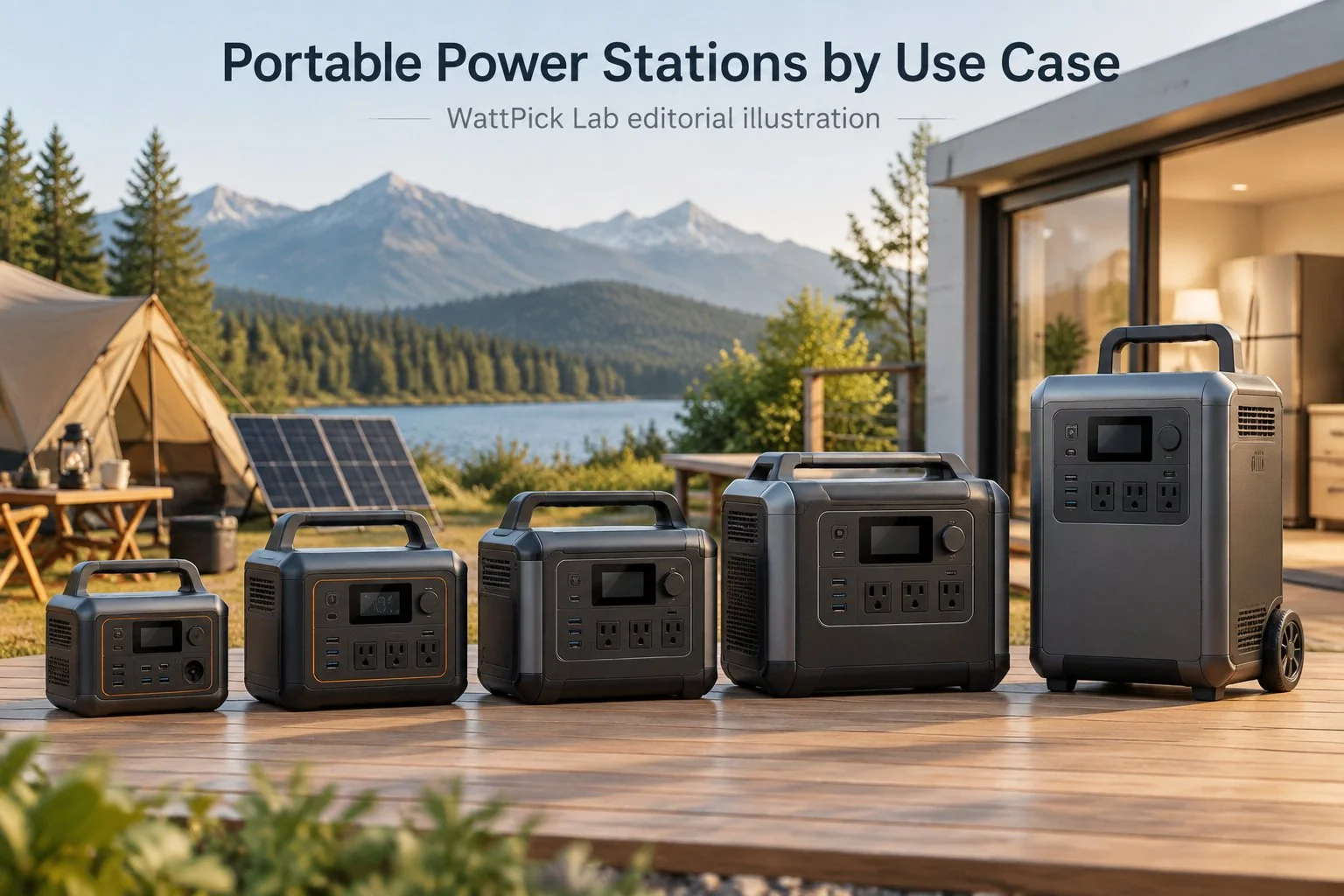
Compact comparison
Compare capacity for duration, output for appliance compatibility, and weight for handling. Figures below are manufacturer-published US specifications; nominal capacity and rated output serve different planning purposes. A larger number is worthwhile only if it solves your particular constraint.
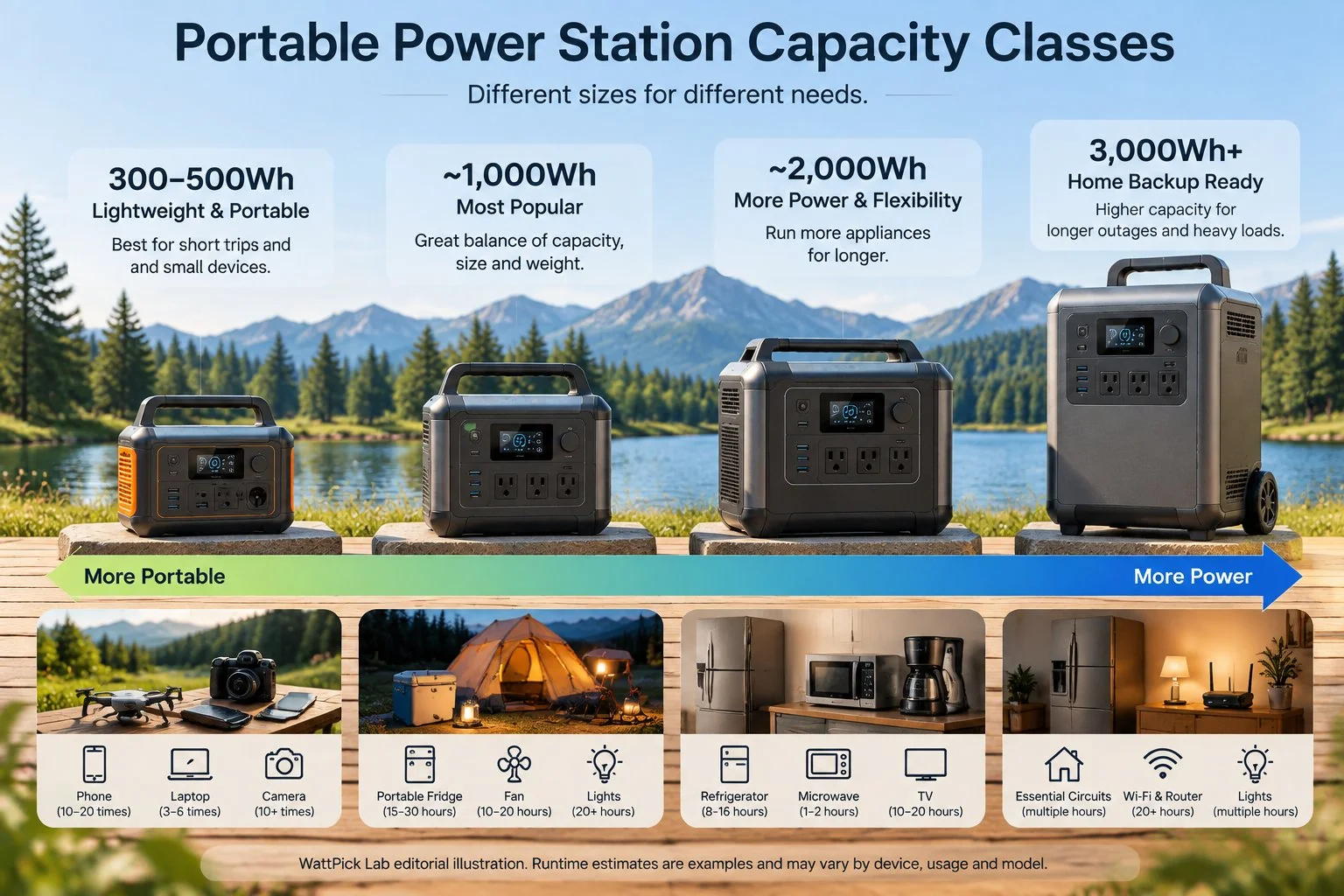
| Model / role | Capacity | AC output | Weight |
|---|---|---|---|
| BLUETTI Elite 100 V2Best Overall | 1,024Wh | 1,800W | ~25.3 lb |
| EcoFlow DELTA 3 PlusBest for Camping | 1,024Wh | 1,800W | ~27.6 lb |
| Jackery Explorer 1000 v2Best Lightweight 1kWh | 1,070Wh | 1,500W | ~23.8 lb |
| Jackery Explorer 2000 v2Best 2kWh | 2,042Wh | 2,200W | ~39.5 lb |
| Anker SOLIX F3800Best for Home Backup | 3,840Wh | 6,000W | ~132.3 lb |
| Jackery Explorer 300Best Small Portable | 293.8Wh | 300W | ~7.1 lb |
Why these picks
Best Overall
BLUETTI Elite 100 V2
Elite 100 V2 is a balanced starting point for movable 1kWh use: 1,024Wh, 1,800W continuous output and about 25.3 lb. Its 1,000W solar-input ceiling helps with a suitable larger array.
Compromise: fixed capacity. Choose it when the load budget fits and recharging is dependable; compare DELTA 3 Plus if battery expansion is a concrete requirement. Panels cannot guarantee replenishment at a shaded campsite.
Best for Camping
EcoFlow DELTA 3 Plus
DELTA 3 Plus combines the 1,024Wh/1,800W class with a documented extra-battery route and 1,000W solar ceiling. It suits a camping plan likely to grow beyond the base station.
Compromise: about 27.6 lb before extra batteries or panels. Confirm compatible accessories and realistic daily solar harvest. Expansion adds cost and weight; it is not necessary for every weekend trip.
Best Lightweight 1kWh
Jackery Explorer 1000 v2
Explorer 1000 v2 puts 1,070Wh in about 23.8 lb, a lighter 1kWh carry choice. Choose it for a planned vehicle-based trip with a budget that fits.
Compromise: 1,500W continuous AC output, 400W solar/DC input and no matching expansion battery. Compare C1000 Gen 2 if output headroom matters more than the small weight saving.
Best 2kWh
Jackery Explorer 2000 v2
Explorer 2000 v2 offers 2,042Wh and 2,200W continuous output in one fixed-capacity unit. It fits a larger energy budget without a modular battery stack.
Compromise: about 39.5 lb and the same 400W solar/DC ceiling as the 1000 v2. More storage takes longer to refill from the same array. Check the lift and recharge plan before stepping up.
Best for Home Backup
Anker SOLIX F3800
The original F3800’s 3,840Wh, 6,000W and documented 120V/240V capability address a different job: demanding compatible loads and planned home-system growth.
Compromise: about 132 lb plus the cost of batteries, connection equipment and installation. Check the original model’s charging/output limits, especially ordinary AC charging with 240V demand. Output alone does not establish multi-day endurance.
Best Small Portable
Jackery Explorer 300
The original Explorer 300 is a small-load alternative: 293.8Wh, 300W continuous AC and about 7.1 lb. It can be a more sensible carry when the job is phones, lights and occasional laptop charging.
Compromise: small energy/output and older NCM chemistry. This is not the LFP 300 Plus. Compare cycle-life endpoints and frequent-use alternatives before choosing from weight alone.
How to Choose
- Energy: add daily device Wh and the gap between reliable recharges, including losses and reserve once.
- Output: check simultaneous power, startup, voltage and actual outlets.
- Handling: budget for the full kit’s weight and the lift you repeat.
- Recovery: match realistic solar or AC opportunities to daily consumption.
Use the calculator, camping guide or solar sizing guide for the detailed planning work.
Methodology
We select from models with substantive reviews already published on WattPickLab. Each role reflects a specific combination of capacity, continuous output, carrying weight, recharging options and ownership constraints. “Best” describes that fit within our researched selection; it does not imply exhaustive market coverage, laboratory superiority or that every buyer needs one of these products.
Our evidence is manufacturer specifications and the source material documented in each linked review. Runtime calculations are planning estimates with stated assumptions. Read the review to verify the exact model and the basis for its recommendation.
The full reviews above contain the product sources and model-specific limitations. Prices, availability, accessories and warranty terms can change; compare equivalent regional bundles at the merchant before purchase. Affiliate participation does not replace the selection criteria. Read our editorial standards for the broader approach.