1kWh / PRODUCT RESEARCH
Anker SOLIX C1000 Gen 2 Review: A Strong 1kWh Pick for Portable Power
1,024Wh, 2,000W output and a 24.9 lb chassis — the useful question is whether roughly 1kWh is the right energy class for your setup.
Affiliate disclosure: WattPick Lab may earn a commission from qualifying purchases through affiliate links, at no additional cost to you. Editorial conclusions are independent of commissions. How our links work.
The Anker SOLIX C1000 Gen 2 sits in one of the most competitive parts of the portable power station market: around 1kWh.
Its formula is straightforward — 1,024Wh of capacity, 2,000W AC output and a 24.9 lb chassis — but those numbers make it relevant to a wide range of buyers, from car campers to households looking for a compact source of outage power.
The important question is not whether the C1000 Gen 2 has enough features.
It is whether roughly 1kWh is the right energy class for your setup.
QUICK VERDICT
Buy it for the 1kWh class, not for growth.
The C1000 Gen 2 is the most portable way into Anker’s line with real appliance headroom: 2,000W of output and 24.9 lb is an unusually useful combination in this class.
The fit checks and the reasons to walk away are set out in full below.
IS THIS THE RIGHT ONE?
Anker SOLIX C1000 Gen 2: who it fits, and who it does not
Best for
- You want enough output to run substantial appliances without moving to a 2–4kWh system
- You expect to carry the station between a house, a vehicle and a campsite
- 1,024Wh matches what you actually use between recharges
Look elsewhere if
- Your estimated daily consumption is already near or above 1kWh
- Expandable battery capacity matters to you
- You are planning around large household or 240V loads
View Current C1000 Gen 2 Price Affiliate link · price and bundle may change.
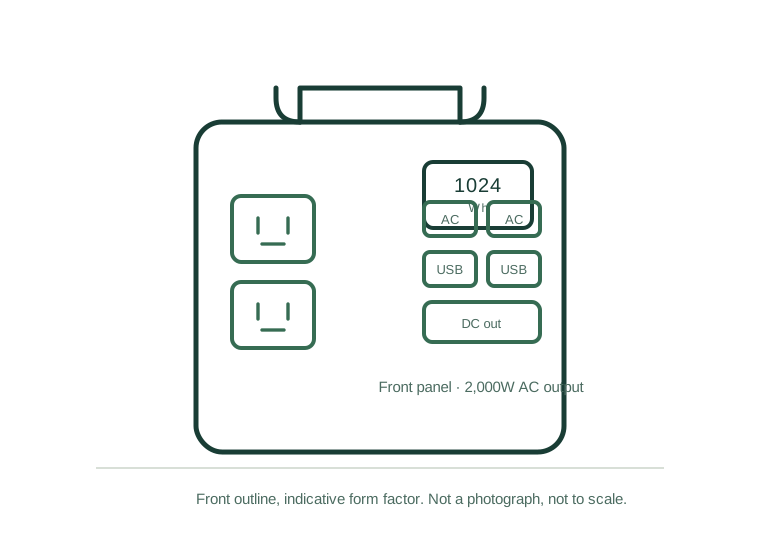
Key specs: what Anker publishes — view the full specification table
| Specification | Published value |
|---|---|
| Battery capacity | 1,024Wh |
| Rated AC output | 2,000W |
| Peak output | 3,000W |
| Weight | 24.9 lb |
| Dimensions | 15.12 × 8.19 × 9.61 in |
| Maximum solar input | 600W |
| UltraFast AC input | 1,600W |
| UPS switchover | 10 ms |
| Expandable capacity | No |
These are manufacturer specifications rather than WattPickLab laboratory measurements. Confirm the current regional manual and warranty terms before buying.
Where the C1000 Gen 2 fits
The C1000 Gen 2 makes the most sense when you want enough output for substantial appliances without moving into a much larger 2–4kWh system.
Its 2,000W rated AC output means the inverter is relatively capable for this capacity class. But capacity and output solve different problems.
Output tells you what the station can run at one time.
Capacity tells you approximately how long it can keep those loads running.
That distinction matters here because a 2,000W inverter does not turn a 1,024Wh battery into an all-day source for a continuous high-wattage load.
1. Portability is one of its strongest arguments
At 24.9 lb, the C1000 Gen 2 stays within a range that is realistic to move between a house, vehicle and campsite.
That matters because buying more capacity almost always means accepting more weight.
The C1000 Gen 2 therefore occupies a useful middle ground: considerably more capability than a small electronics-focused battery, without turning into a large wheeled home-backup system.
For buyers who regularly load and unload their power station, that trade-off can matter more than maximizing battery capacity.
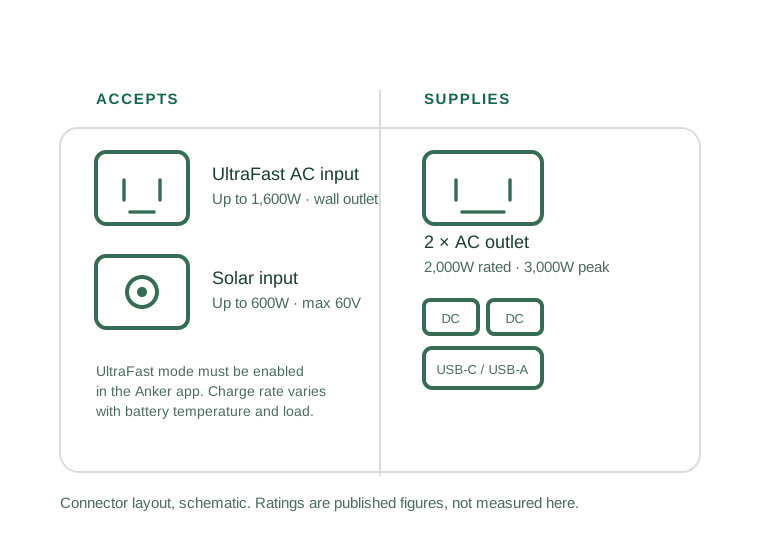
2. 2,000W output gives it broad appliance coverage
Anker rates the C1000 Gen 2 for 2,000W AC output with 3,000W peak output.
That gives it substantially more appliance flexibility than the capacity figure alone might suggest.
But equipment should still be checked individually. Look at both the device’s continuous power requirement and any startup surge before assuming compatibility.
And remember:
Being able to run a load does not mean being able to run it for a long time.
A high-wattage appliance can consume a 1kWh-class battery quickly. For runtime planning, calculate energy consumption separately from inverter capability.
3. Fast recharging is useful when turnaround time matters
Anker specifies up to 1,600W UltraFast AC charging for the C1000 Gen 2.
The company advertises a full recharge in as little as 49 minutes under its UltraFast conditions. UltraFast mode must be enabled through the Anker app, and actual charging behavior can vary with conditions such as battery temperature. That 49-minute figure is Anker’s claim, not our measurement.
For ordinary buying decisions, the more useful takeaway is simple:
This is designed to be a fast-turnaround 1kWh station.
That can matter on road trips or during intermittent outages when access to grid power is limited to short windows.
For off-grid charging, the C1000 Gen 2 accepts up to 600W of solar input.
Anker states approximately 1.8 hours for a full solar recharge under its specified maximum-input conditions. Real-world solar charging will depend heavily on sunlight, panel orientation, temperature and actual panel output. See our solar generator buying guide.
4. The biggest trade-off is expansion
This is the specification buyers should not miss.
The C1000 Gen 2 does not support an expansion battery.
That is not necessarily a problem.
If ~1kWh already matches your use case, avoiding a larger expandable system can keep the setup smaller and easier to move.
But if you already expect to need substantially more energy later, the lack of expansion changes the decision.
Instead of asking:
“Can I add another battery later?”
ask:
“Is 1,024Wh actually the capacity class I want to own?”
If the answer is no, moving directly to an S2000, F3000 or another larger system may be cleaner. See which Anker SOLIX model fits your setup →
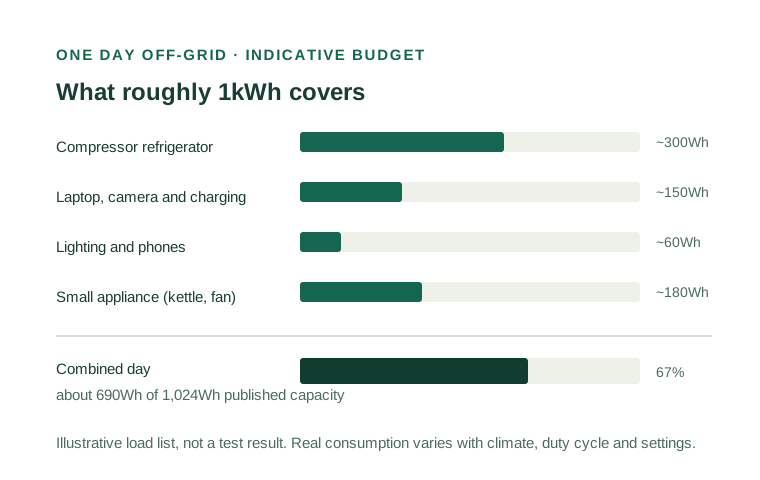
C1000 Gen 2 for camping
Camping is one of the clearest use cases for this model.
The combination of 1,024Wh capacity + 24.9 lb weight + 2,000W output gives it enough flexibility for many car-camping setups without making transportation unnecessarily difficult.
For lighter trips, however, 1kWh may still be more battery than you need. For longer stays with refrigeration and multiple devices, the opposite may be true.
That is why we would choose the capacity class from your expected energy use rather than simply buying the largest station you can afford. Compare the best portable power stations for camping →
What about home backup?
The C1000 Gen 2 can be useful during an outage, but it should be viewed as portable backup, not as a substitute for a large whole-home system.
It can make sense for selected essentials such as communications equipment, lighting, refrigeration or other compatible loads.
If your goal starts involving longer runtimes, large household loads, expandable storage or 240V equipment, you are moving into a different product category.
Within Anker’s lineup, that is where models such as the F3000 and F3800 become more relevant.
C1000 Gen 2 vs larger Anker SOLIX models
The easiest way to decide whether the C1000 Gen 2 is enough is to identify what would force you to move up.
| Your constraint | Model class to investigate |
|---|---|
| ~1kWh is enough and portability matters | C1000 Gen 2 |
| You mainly need more stored energy | S2000 |
| You want a much larger expandable reserve | F3000 |
| You need native 120V/240V and serious home backup | F3800 |
The C1000 Gen 2 is therefore not the “small F3800.” It serves a different job: portable, mainstream 1kWh power.
Alternatives worth comparing
Explorer 1000 v2
Lighter, different trade-offs.
Read review →DELTA 3 Plus
Charging and solar alternative.
Compare →Elite 100 V2
Another 1kWh finalist.
Compare →FINAL VERDICT
A strong 1kWh pick, if 1kWh is the right class.
The C1000 Gen 2 makes the strongest case when you want a mainstream 1kWh power station that remains genuinely portable. Its 2,000W AC output gives it broad appliance flexibility, while the 24.9 lb weight keeps it much easier to move than larger backup-focused systems. Fast AC charging and 600W maximum solar input further strengthen its fit for travel and intermittent off-grid use.
The main reason not to choose it is equally straightforward: 1,024Wh is the capacity you are buying. It is not expandable. If that amount of energy fits your camping, travel or short-backup requirements, the C1000 Gen 2 deserves a place on the shortlist. If you already know you need substantially more runtime, start in a larger capacity class instead.
Frequently asked questions
Can the Anker SOLIX C1000 Gen 2 use an expansion battery?
No. Anker specifies that the C1000 Gen 2 does not support expandable capacity, so 1,024Wh is the capacity you own.
How much solar can the C1000 Gen 2 accept?
Anker specifies a maximum solar input of 600W, with a maximum input voltage of 60V.
How heavy is the C1000 Gen 2?
Anker lists the net weight at 24.9 lb.
Is the C1000 Gen 2 suitable for home backup?
It can power selected compatible essentials during an outage, but its 1,024Wh capacity places it closer to portable backup than a large expandable home-backup system.
Research basis
Sources & methodology
Sources checked September 30, 2026. This article covers the original US C1000 Gen 2. We distinguish Anker’s claims from our own calculations and assumptions. We have not tested this unit for our own performance, noise or reliability measurements.
- Anker SOLIX C1000 Gen 2 product page ↗ — manufacturer specifications used throughout this review.
- WattPick Lab: Best Anker SOLIX power stations ↗ — cross-model comparison and the ladder this review is placed on.
- WattPick Lab editorial standards ↗ — how we separate published specifications from our own labelled calculations.
Specifications and product availability can change; verify current configuration and compatibility before purchasing. Anker’s 49-minute recharge and 1.8-hour solar figures are manufacturer claims made under stated maximum-input conditions, not results measured by WattPick Lab.
Deciding between two 1kWh stations?
The C1000 Gen 2 is the output-forward option in this class. See how it measures against the other 1kWh finalists.