JACKERY / THREE MODELS / 300Wh TO 2kWh
Best Jackery Power Stations: How to Pick the Right One
The 60-second answer
Three models, three jobs. Choose the Explorer 300 if you only run small loads and carrying weight matters. Choose the Explorer 1000 v2 if you want roughly 1kWh for mainstream camping at 23.8 lb. Choose the Explorer 2000 v2 if you need longer runtime — a larger energy budget, loads above 1,500W, or long gaps between recharges.
We may earn a commission through the merchant links on this page, at no extra cost to you. Affiliate disclosure.
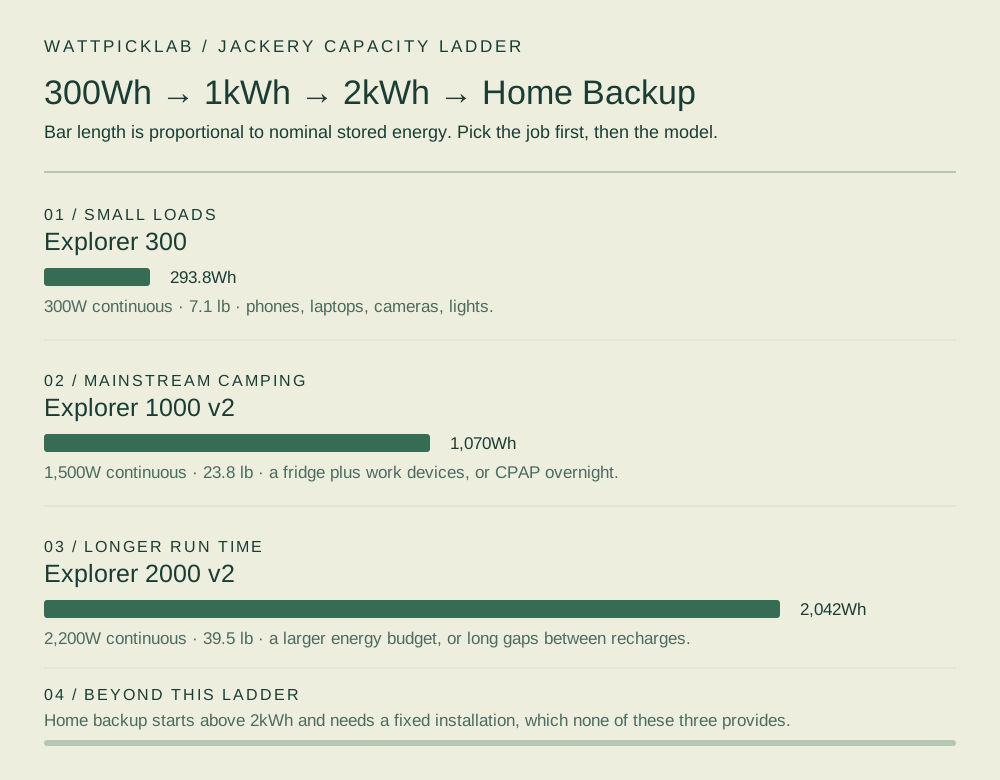
The three models, side by side
| Specification | Explorer 300 | Explorer 1000 v2 | Explorer 2000 v2 |
|---|---|---|---|
| Nominal capacity | 293.8Wh | 1,070Wh | 2,042Wh |
| Continuous AC output | 300W (500W surge) | 1,500W | 2,200W (4,400W surge) |
| Weight | 7.1 lb | 23.8 lb | 39.5 lb |
| Max DC / solar input | Not published here | 400W | 400W |
| Battery chemistry | NCM lithium-ion, 800 cycles to ≥80% | LiFePO₄, 4,000 cycles to 70%+ | LiFePO₄, 4,000 cycles to 70%+ |
| Best for | Small devices carried on foot | Mainstream camping, fridge or CPAP | A larger energy budget, fewer recharges |
| Main limitation | Little reserve; no high-power cooking | 1,500W ceiling; ~1kWh leaves little slack | 39.5 lb; still not a home installation |
| Price | View Current Explorer 300 Price → | View Current Explorer 1000 v2 Price → | View Current Explorer 2000 v2 Price → |
Affiliate links earn us a commission at no cost to you and do not affect which model is named here. Every figure is a manufacturer claim or a labelled calculation — we have not tested any of these units. How our links work.
The short verdict on each
SMALL LOADS
Explorer 300 — the one you can actually carry
What it is. A 293.8Wh station rated at 300W continuous (500W surge) that weighs 7.1 lb. That is about a third of the energy of the 1000 v2 in a package roughly a third of the weight.
What it covers. Phones, laptops, cameras, LED lighting and small fans across a weekend. It fits a packing strategy where the station rides in a day pack rather than a vehicle.
Where it stops. A compressor fridge over several days, or any high-power cooking, will exhaust it quickly. The original model also uses NCM lithium-ion cells rated at 800 cycles to at least 80% capacity — a shorter published cycle life than the LiFePO₄ cells in the two larger units. Do not apply the newer 300 v2’s chemistry or cycle figure to this product.
Choose it if: your loads are small, you carry the station any real distance, and you recharge between trips.
Skip it if: a fridge, CPAP or cooking is part of the plan.
MAINSTREAM CAMPING
Explorer 1000 v2 — the default choice
What it is. 1,070Wh, 1,500W continuous AC output, 23.8 lb, and up to 400W of solar or DC input. LiFePO₄ cells rated at 4,000 cycles to 70%+ remaining capacity.
What it covers. A camping fridge on a normal duty cycle, a laptop, lights and fans, or a CPAP overnight — the mainstream car-camping and RV pattern of two to four nights.
Where it stops. The 1,500W ceiling rules out most high-power cooking, and its 23.8 lb is the lightest in this size class but still a two-hand carry. The 1,070Wh label is only about 4.5% above a 1,024Wh battery, so treat it as a 1kWh unit rather than an upgrade on one.
Choose it if: one station has to cover a normal camping trip and you would rather carry less than buy output headroom.
Skip it if: you need more than about 1kWh between recharges, or you run appliances near 1,500W.
LONGER RUN TIME
Explorer 2000 v2 — when 1kWh is not enough
What it is. 2,042Wh, 2,200W continuous (4,400W surge), 39.5 lb and the same 400W DC input ceiling. About 91% more nominal energy than the 1000 v2, at 15.7 lb more.
What it covers. Longer gaps between recharging, a heavier load list, or several people sharing one battery. The higher output headroom also accommodates appliances the 1000 v2 cannot start.
Where it stops. At 39.5 lb it is a vehicle-mounted or garage-stored unit rather than something you hike with. And 2kWh is still portable-scale: it is not a home installation, and it does not integrate with a house circuit the way a fixed backup system does.
Choose it if: your energy budget is genuinely larger, or you rarely get the chance to recharge.
Skip it if: a 1kWh unit covers your trip — you would be carrying 15.7 lb for capacity you never use.
Should you move up a size?
Moving up is a one-way trade: more stored energy in exchange for more weight. Use this table before you decide.
| If this is your constraint | Move to | Why |
|---|---|---|
| The 300Wh class cannot cover your loads | Explorer 1000 v2 | 293.8Wh leaves no reserve once a compressor fridge, an overnight CPAP or a larger load list is involved; 1kWh absorbs it. |
| Roughly 1kWh leaves too little reserve | Explorer 2000 v2 | The 2,042Wh unit stores about 91% more nominal energy, which buys time rather than a different load list. |
| 2kWh is still not enough | A home-backup system | When the requirement is whole-home, circuit-level or long-duration power, a portable station is the wrong class of product — see our home-backup pick. |
Not sure yet? Pick your next step
Going camping?
Not sure how much capacity you need?
Need home backup?
Frequently asked questions
Should I buy the Explorer 1000 v2 or the Explorer 2000 v2?
Buy the Explorer 1000 v2 when roughly 1kWh covers your trip and you would rather carry 23.8 lb. Buy the Explorer 2000 v2 when your energy budget is larger, you run loads near or above 1,500W, or you cannot recharge often. The 2,042Wh unit stores about 91% more nominal energy than the 1,070Wh one and weighs 15.7 lb more.
Is the Explorer 300 enough for camping?
For phones, laptops, cameras, lights and small fans, yes. It is rated at 293.8Wh with 300W continuous output and weighs 7.1 lb. It is not sized for a compressor fridge over several days or for high-power cooking. The original Explorer 300 uses NCM cells rated at 800 cycles to at least 80% capacity, which is lower than the LiFePO₄ rating on the two larger models.
How much Jackery capacity do I need?
Estimate the watt-hours your devices use between charges, then add a reserve. Under about 300Wh suits small devices. About 1kWh suits a fridge plus work devices or overnight CPAP. About 2kWh suits longer gaps between recharging or larger loads. Use a runtime estimate rather than buying the largest unit available.
How we compare Jackery power stations
This page is a model decision, not a product test. We compare only manufacturer-published specifications for US models — capacity, continuous output, weight, input ceilings and stated chemistry — and label every derived figure as an estimate. We have not measured usable energy, runtime, noise or reliability for any of these units.
Our Explorer 300, Explorer 1000 v2 and Explorer 2000 v2 reviews carry the full verification record for each model. Cycle-life endpoints are quoted as the manufacturer states them and are not directly comparable across the three.
Jackery US specifications checked September 28, 2026: Explorer 300 · Explorer 1000 v2 · Explorer 2000 v2.