PRODUCT RESEARCH / UNDER-SINK REVERSE OSMOSIS
Frizzlife PD600-TAM3 Review: 600 GPD RO With Remineralization
A 600 GPD tankless system with a separate remineralization module. We have not run this unit in a lab — this review is built from Frizzlife’s listings, cartridge pages and the standards it cites.
Affiliate disclosure: WattPick Lab may earn a commission when you purchase through links on this page, at no additional cost to you. It does not change what we recommend. How our links work.
QUICK VERDICT
A tankless RO system that puts minerals back on purpose.
The PD600-TAM3 is a tankless under-sink reverse-osmosis system rated at 600 GPD with a 2:1 pure-to-drain listing, a real-time TDS display and a separate TAM3 remineralization stage. The flow figure is ordinary for this class. The third stage is not. [1] [2]
The buying question is not 600 GPD against 800 GPD. It is whether you want the water changed after the membrane, and whether two housings fit your cabinet.
IS THIS THE RIGHT ONE?
Frizzlife PD600-TAM3: who it fits, and who it does not
Best for
- You have already chosen under-sink RO over a countertop machine
- 600 GPD and 0.41 GPM cover how you draw water
- You specifically want minerals added back after reverse osmosis
- You want the TDS reading on the unit itself
- Your cabinet can take two components, not one box
Look elsewhere if
- You want a no-plumbing countertop system
- Maximum flow matters more than remineralization
- You want the simplest possible filter arrangement
- Cabinet space is already tight
View Current Frizzlife PD600-TAM3 Price Affiliate link · check the seller, the bundle and the current price.
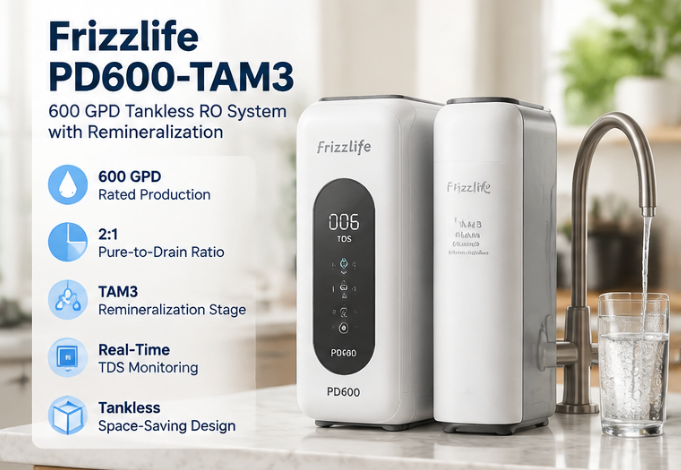
Key specs: what Frizzlife publishes — view the full specification table
| Specification | Published figure | What it actually tells you |
|---|---|---|
| Configuration | Under-sink, tankless | No pressure tank, so it produces on demand and needs an outlet. |
| Rated production | 600 GPD | A rated daily figure at stated conditions, not a measured flow. |
| Listed flow rate | Approx. 0.41 GPM | The same capability per minute. Cold supply water lowers it. |
| Pure-to-drain | 2:1 listed | Two parts purified to one part reject, rated rather than metered. |
| RO membrane | 0.0001 µm nominal | A nominal pore rating, not a contaminant-by-contaminant guarantee. |
| Remineralization | Yes — separate TAM3 module | A third stage after the membrane that adds selected minerals back. |
| TDS monitoring | Real-time outlet TDS | Reads after the TAM3 stage, so the number can sit above membrane output. |
| PD600 housing | 5.3 × 14.7 × 15.5 in | The main unit — one of two components you have to place. |
| TAM3 module | Approx. 6.0 × 5.0 × 13.5 in | Frizzlife publishes two values: 5 × 5 × 13.5 in in its listing, about 6.0 in across in its diagram. Plan for the larger. |
| Cartridges | ASR211, ASR212-600G, FZ-4 | Three part numbers with three intervals — no single annual filter. |
| Power | Requires an outlet | A pumped system, so it delivers no water during a power cut. |
GPD = gallons per day. Rated figures are published at manufacturer test conditions, and cold or low-pressure supply water reduces real output. WattPick Lab has not independently laboratory-tested these figures.
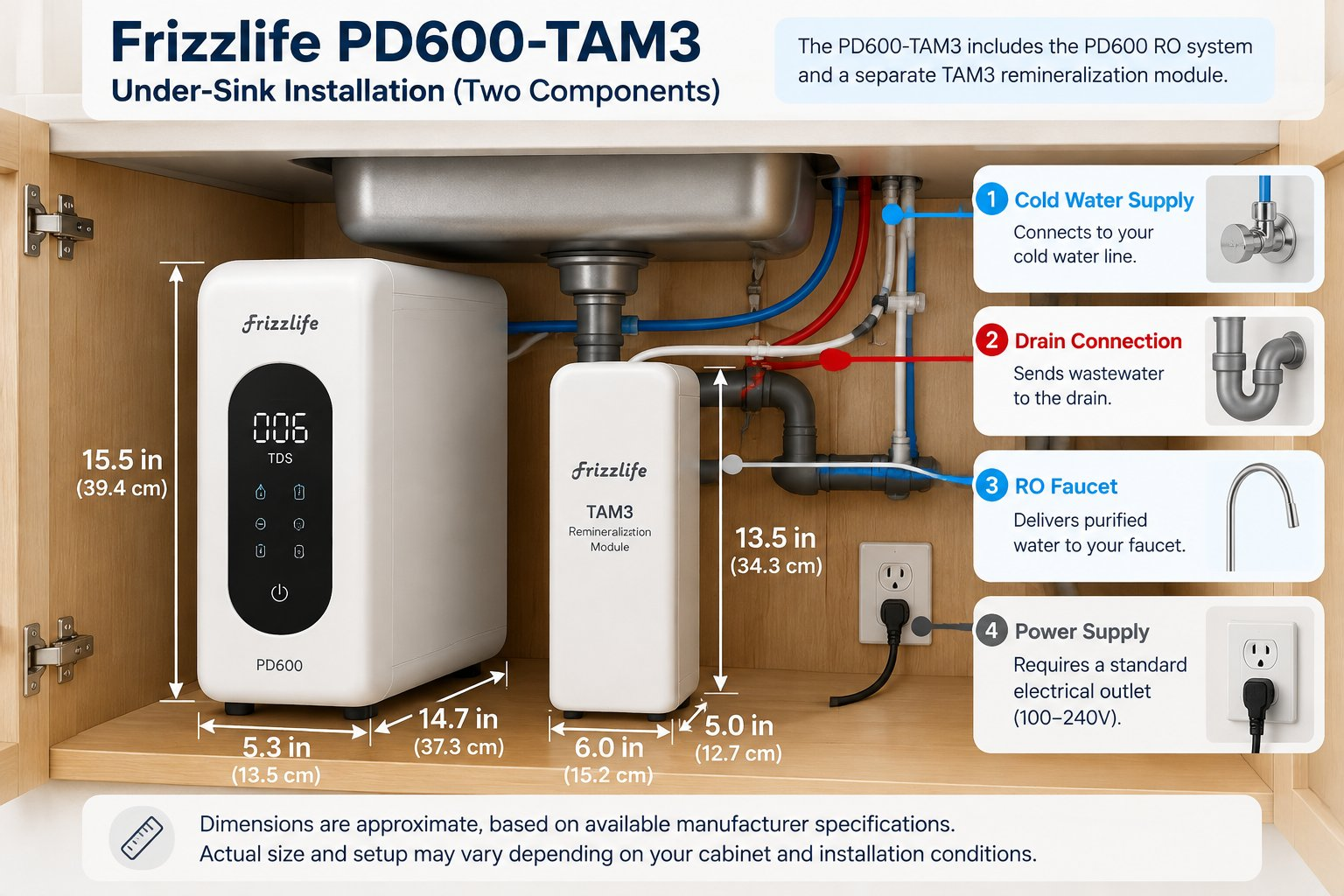
Start with the system layout
The PD600-TAM3 is not one box. The setup pairs the PD600 reverse-osmosis system with a separate TAM3 remineralization module, and both go under the sink. Cabinet planning has to account for two housings plus the tubing between them. [1]
Tankless removes the pressure tank, not the plumbing. You still need a cold-water feed, a drain route, an opening for a dedicated faucet and an outlet for the pump. Renters who cannot modify the sink should treat those four as decisive.
1. What does 600 GPD mean in everyday use?
Frizzlife rates the PD600 at 600 gallons per day and lists a flow rate of about 0.41 gallons per minute. Both describe what the system can produce, not how much water a household is expected to drink. [1]
The practical question is narrower: can the faucet fill a glass, a coffee maker, a kettle or a cooking pot fast enough that you stop thinking about it? A tankless system produces on demand rather than refilling a tank, so there is no tank to run dry mid-dinner.
Output moves with incoming pressure, temperature, water quality and filter condition, so treat both figures as manufacturer specifications rather than independent WattPick Lab measurements.
2. TAM3 is the feature that really separates this system
Reverse osmosis removes dissolved substances. Some buyers want the near-neutral result; others want minerals added back afterwards. That is the TAM3 module’s job: an alkaline remineralization stage that adds selected minerals after the membrane and changes the final taste. [1]
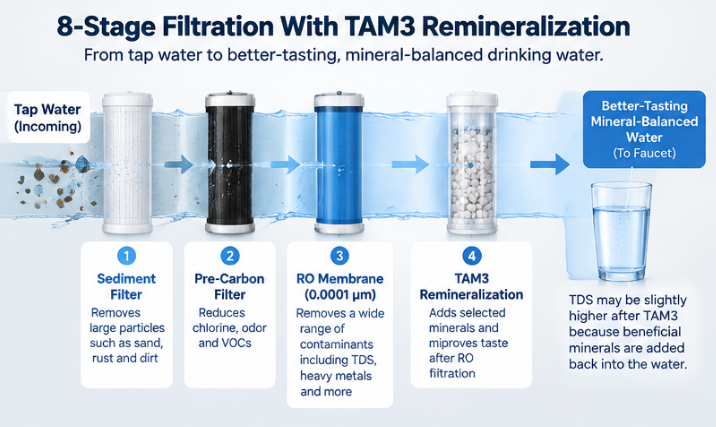
That is a TDS nuance worth knowing before you compare numbers. Frizzlife notes that water measured after TAM3 can read somewhat higher TDS than water leaving the RO membrane, precisely because minerals have been added back. [1] Compare outlet TDS across two systems without knowing where each probe sits and you will misrank them.
3. “8-stage” is less important than the evidence behind the claims
Frizzlife markets the PD600-TAM3 as an eight-stage system — sediment and carbon filtration, a 0.0001 µm RO membrane and post-RO remineralization — and publishes contaminant-reduction claims. Three different things are blended together there. [1]
Manufacturer claims are what Frizzlife says the system reduces. Third-party testing is separate: Frizzlife states the system was tested by SGS to NSF/ANSI 42, 53 and 58, and its listings also name NSF/ANSI 372. Our testing is nothing — we have not laboratory-tested this unit.
Aesthetic effects
Taste, odour and chlorine. Not a health-contaminant claim.
Named health-effect claims
Specific contaminants only — the ones on the certified sheet.
Reverse osmosis
Written for RO: TDS reduction, efficiency and recovery.↗
Component lead content
A materials requirement, not a claim that the filter removes lead.↗
A standards reference is not proof that every contaminant is reduced. For a substance that matters in your home, verify that exact claim in the current documentation for the model you are buying.
4. The 2:1 pure-to-drain ratio
Frizzlife’s current US listing specifies a 2:1 pure-to-drain ratio: roughly two parts purified water for every one part sent to drain under the manufacturer’s rated conditions. [1]
That is more informative than a generic water-saving badge, but it is still a rated specification. Real recovery shifts with supply pressure, temperature, incoming TDS and membrane condition.
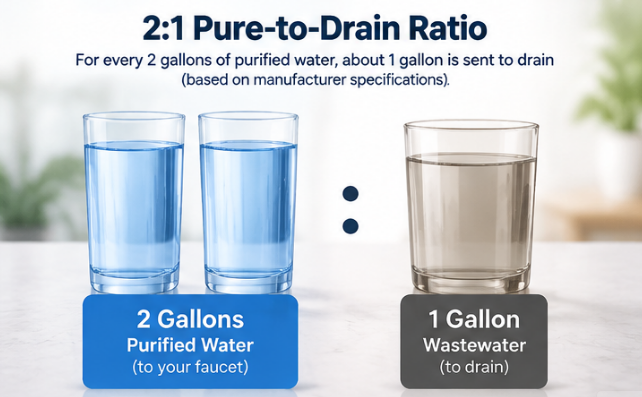
Against the Waterdrop G3P800’s advertised 3:1, this is the clearest single difference between the two systems — and the one most often reduced to a GPD comparison. [9]
5. Maintenance includes the RO system and the TAM3
The PD600-TAM3 has more than one maintenance path because it is more than one component. Frizzlife lists three cartridges for this model: ASR211, the first-stage composite filter, at 12 months; ASR212-600G, the RO membrane, at 24 months; and FZ-4 for the TAM3 stage, also at 12 months. [2] [3] [4] [5]
The TAM3 housing is designed so the inner cartridge can be replaced without discarding the outer housing. [8] Before buying we would check four things:
- Each cartridge price. Three part numbers, three prices, and they differ.
- Each stated interval. Twelve, twenty-four and twelve months — they fall in different months.
- How many cartridges the setup takes. A single annual filter price does not describe this system.
- Whether your water pulls them forward. Sediment and hardness shorten filter life regardless of the calendar.
Filter-life figures are estimates, not guarantees, and they assume municipal feed water; a hard or heavily sedimented supply brings changes earlier.
6. Tankless saves space — but TAM3 uses some of it back
The PD600 itself is narrow: Frizzlife lists it at approximately 5.3 × 14.7 × 15.5 in. The TAM3 module is a second housing. The listing gives 5 × 5 × 13.5 in, the installation diagram shows about 6.0 in across. If you are measuring, plan for the larger figure. [1]
So the honest version of “tankless saves space” is narrower than the slogan. You lose the pressure tank; you do not lose a component. Two housings and their tubing compete for cabinet space with the disposal and the dishwasher connection.
Measure the cabinet you have, not the one in the photograph, and check you can still reach the shutoff.
Who should choose the PD600-TAM3?
Household size alone does not decide this: a two-person home runs it happily, and a large family filling jugs all day will find 0.41 GPM tight. What decides it is whether you want remineralization at all, and whether the cabinet holds two housings.
If those two fit, the TAM3 stage is the reason to choose this model over other 600 GPD systems. If they do not, it is just a third cartridge to buy. [1]
PD600-TAM3 vs Waterdrop G3P800
The closest comparison here is not 600 against 800. It is what each system does with the water after the membrane.
FRIZZLIFE PD600-TAM3
Remineralization is the point
- 600 GPD rated and roughly 0.41 GPM listed.
- A 2:1 pure-to-drain listing.
- Dedicated TAM3 remineralization stage after the membrane.
- Three cartridges: ASR211, ASR212-600G and FZ-4.
WATERDROP G3P800
Higher output, no mineral stage
- 800 GPD rated and an advertised 3:1 ratio.
- UV stage in the equipped configuration.
- Smart faucet with TDS and filter-life display.
- No post-RO remineralization in the base configuration.
The G3P800 is the stronger candidate if higher rated output and a different pure-to-drain profile matter more. The PD600-TAM3 becomes the more interesting choice when post-RO remineralization is something you actually want rather than a stage count you were sold. We have measured neither. See both side by side →
What if you don’t want remineralization?
Then do not assume the PD600-TAM3 is better because it carries one more stage. Remineralization is a preference: some buyers want the taste and the mineral profile, others prefer the RO output with nothing added back. Choose the water profile you want rather than a larger stage count. [1]
If you want neither the under-sink plumbing nor the extra stage, the countertop route removes both — see the full reverse osmosis comparison.
FINAL VERDICT
Buy it for the TAM3 stage, not for the GPD figure.
The PD600-TAM3 makes its strongest case for buyers who want three things together: tankless under-sink RO, everyday flow that is adequate rather than exceptional, and minerals deliberately added back after the membrane. 600 GPD is the least distinctive number on this page; the TAM3 module is the most.
That stage changes both the final water profile and the physical layout, which is why this model should be judged as a complete RO-plus-remineralization setup rather than another 600 GPD filter. If that matches what you want and the cabinet takes two components, it belongs on your shortlist. If higher rated output matters more, put it against the Waterdrop G3P800 first.
Frequently asked questions
Is the Frizzlife PD600-TAM3 tankless?
Yes. The PD600 is a tankless under-sink RO system. The complete setup adds the separate TAM3 remineralization module, so it is two housings rather than one box.
What is the rated flow of the PD600-TAM3?
Frizzlife lists 600 GPD and about 0.41 GPM. Both are rated figures at stated conditions, not a measurement of your tap.
What does the TAM3 module do?
It is a post-RO remineralization stage. Frizzlife says it adds selected minerals back after reverse osmosis to change the final taste and mineral profile. Outlet TDS can read slightly higher than water leaving the membrane as a result.
What is the rated pure-to-drain ratio?
Frizzlife’s current US listing specifies 2:1 under rated conditions. Actual recovery changes with supply pressure, temperature, incoming TDS and membrane condition.
Is the PD600-TAM3 certified?
Frizzlife states the system has been tested by SGS to NSF/ANSI 42, 53 and 58, and its listings also name NSF/ANSI 372. A standards reference is not proof that every contaminant is reduced — verify the exact claim you care about.
Research basis
This review is built from documents, not from a unit in our hands. We have not installed, tested, measured or tasted a PD600-TAM3, and nothing here is a laboratory result.
What we used: Frizzlife’s US product listing, its replacement-filter pages for cartridge part numbers and intervals, and the NSF pages for the standards it cites. Where a brand names several standards at once we separate what each covers, and where it publishes two figures for the same part we give both. Specifications and prices move, so verify before you buy; we do not assign a star rating from specifications alone.
Four figures accompany this page — the unit, the two-housing layout, the TAM3 stage and the drain ratio, one per buying question. All are WattPick Lab editorial illustrations, not photographs, not to scale and not test results. See our evidence and editorial standards.
Sources
- Frizzlife PD600-TAM3 US product page ↗
- Frizzlife replacement filter page ↗
- ASR211 first-stage cartridge ↗
- ASR212-600G RO membrane cartridge ↗
- FZ-4 remineralization cartridge ↗
- NSF: what Standard 58 covers ↗
- NSF: Standard 372 and component lead content ↗
- TAM3-HF replacement kit ↗
- Waterdrop G3P800 US product page ↗