COMPARISON / UNDER-SINK RO / US MODELS
Waterdrop G3P800 vs Frizzlife PD600-TAM3: Which Tankless RO Fits Your Kitchen?
Both are tankless under-sink systems that need a cabinet, a drain and an outlet. Waterdrop spends the difference on output, a lower waste ratio and a UV stage; Frizzlife spends it on putting minerals back after the membrane.
Affiliate disclosure: WattPick Lab may earn a commission from qualifying purchases made through links on this page, at no additional cost to you. Editorial conclusions are independent of commissions. How our links work.
30-SECOND ANSWER
More water and less waste, or minerals added back?
Neither system is simply the better one. Both are tankless under-sink units that need an outlet, and both list the same 0.0001 µm nominal membrane rating. What differs is output, the pure-to-drain ratio, the stage after the membrane and the cartridge bill. [1] [2]
Take the G3P800 if the water itself is the point. It is rated at 800 GPD against 600 GPD, advertises a 3:1 ratio against 2:1, and adds a UV stage.
Take the PD600-TAM3 if you want minerals put back. Its TAM3 module is a third stage after the membrane, and at listed prices its cartridges come to less a year. You give up output, ratio headroom and a single-housing footprint.
One-line rule: take the G3P800 for the most water and the least waste, and the PD600-TAM3 for remineralization and a smaller cartridge bill.
Live pricing
View Current Waterdrop G3P800 Price View Current Frizzlife PD600-TAM3 Price Both are tankless systems that need an outlet. Confirm the exact model, the bundle contents and the delivery date at the retailer.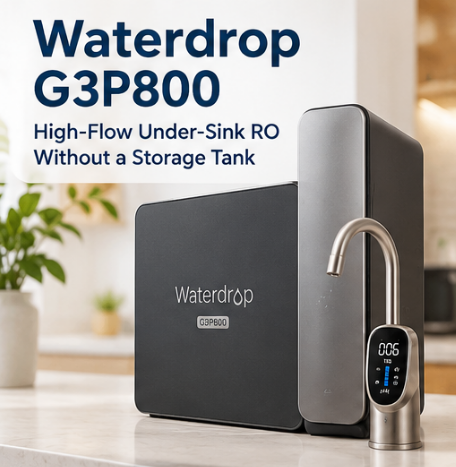
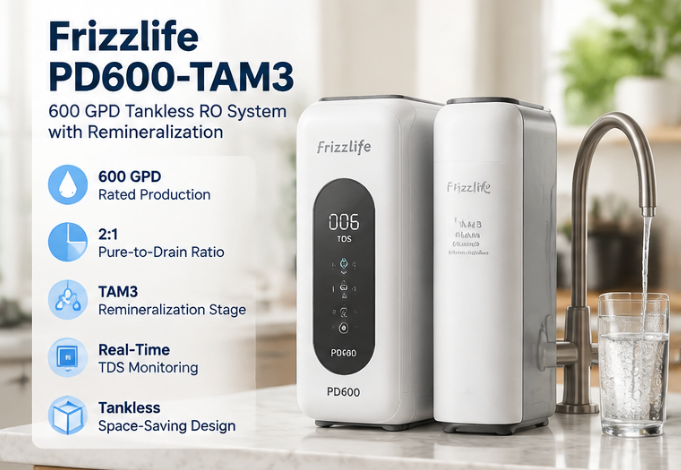
Key differences at a glance
Published figures from both manufacturers. Where a difference changes what you buy, it gets its own section below.
| Specification | Waterdrop G3P800 | Frizzlife PD600-TAM3 |
|---|---|---|
| Configuration | Under-sink, tankless | Under-sink, tankless, plus TAM3 |
| Rated output | 800 GPD | 600 GPD, approx. 0.41 GPM |
| Pure-to-drain | 3:1 advertised | 2:1 listed |
| RO membrane | 0.0001 µm nominal | 0.0001 µm nominal |
| After the membrane | UV stage, equipped configuration | TAM3 remineralization module |
| Certification | IAPMO R&T to NSF/ANSI 42, 53, 58 and 372 | SGS-tested to NSF/ANSI 42, 53 and 58, plus 372 |
| Filter indicator | Smart faucet, TDS and filter life | Real-time outlet TDS |
| Cartridges | Three: composite, carbon block, RO membrane | Three: ASR211, FZ-4, ASR212-600G |
| Nominal intervals | Up to 6, 12 and 24 months | 12, 12 and 24 months |
| Footprint | One unit, one faucet | Two housings |
Sources: both manufacturers’ published product information for the US models, listed under Sources & editorial method. A certification entry names the standards a manufacturer reports testing against for a specific model, not that every contaminant is reduced. Figures are WattPick Lab editorial illustrations; product appearance and trademarks belong to their respective owners.
1. Output: 800 GPD against 600 GPD
This is the difference a specification sheet makes look bigger than it is in a kitchen. Both are rated daily production at stated conditions rather than a measurement at your tap, and neither manufacturer publishes a flow rate on the same basis. Waterdrop rates the G3P800 at 800 GPD; Frizzlife rates the PD600-TAM3 at 600 GPD and lists about 0.41 GPM beside it. [1] [2]
For filling bottles, a kettle and a pan, either system keeps up. The gap shows under sustained draw — a large vessel, or two people using the kitchen at once — and it widens when supply pressure or water temperature sits outside the rated window.
What the extra output does not do is change the water. If your demand is ordinary, 600 GPD will not feel like a limit.
2. Water waste: an advertised 3:1 against a listed 2:1
Pure-to-drain is the ratio of water delivered to water rejected. Waterdrop advertises 3:1 for the G3P800; Frizzlife lists 2:1 for the PD600-TAM3. Both are rated at stated conditions, neither is metered, and both move with supply pressure, temperature, incoming TDS and the state of the membrane. [1] [2]
The difference is real but conditional. At the rated condition the G3P800 sends proportionally less water to the drain, which is a running-cost advantage rather than a performance one. In a house with low pressure or cold supply water, both systems move off their published figure and the gap can narrow.
If you are on metered water, the ratio deserves real weight. If you are not, it should not outrank output or the cartridge bill.
3. After the membrane: UV against TAM3 remineralization
This is the only difference here that changes what comes out of the faucet rather than how much of it there is. The G3P800 adds a UV stage in the equipped configuration. Frizzlife takes the opposite route: the PD600-TAM3’s third stage is a TAM3 module that Frizzlife describes as adding selected minerals back after reverse osmosis, altering the mineral profile of the finished water. [1] [2]
So the question is not which stage is better but whether you want minerals added back at all. Frizzlife markets the stage partly around taste, and we have not taste-tested either system.
4. Cabinet space: one unit against two housings
Under-sink RO is an installation decision before it is a performance one. The G3P800 is a single tankless unit with the UV stage inside it, plus clearance for a smart faucet. The PD600-TAM3 is deliberately two components: the PD600 body, published at 5.3 × 14.7 × 15.5 in, and the separate TAM3 module, which Frizzlife publishes as 5 × 5 × 13.5 in in its listing and as about 6.0 in across in its diagram. [2]
Plan around that discrepancy rather than resolving it: assume the larger figure when you measure. A cabinet that takes one unit comfortably may not take two, and a shallow cabinet already holding a disposal and a bin is the most common reason an under-sink system goes back.
5. Cartridges: three each, priced differently
Both run on three cartridges, and neither is a single annual filter. Waterdrop lists a composite at up to six months, a carbon block at up to twelve and the membrane at up to twenty-four. Frizzlife lists ASR211 at twelve months, FZ-4 at twelve and ASR212-600G at twenty-four. [1] [3]
FIVE-YEAR PLANNING EXAMPLE
About $160 a year against about $107.
At listed prices and nominal intervals the G3P800’s base cartridges annualise to roughly $160, and five years come to $729.83 once the set that ships with the system is excluded. The PD600-TAM3’s three — $33.99, $29.99 and $85.99 — annualise to about $107, or roughly $492 over the same window.
Arithmetic from published prices and intervals, not a quote. It assumes the time limits trigger every replacement and that prices hold; purchase price, installation, electricity and drain losses sit outside it, and your water can pull either schedule forward.
Intervals are ceilings rather than promises, so read the gap as a planning figure — and still the cost most likely to surprise you in year three.
CHOOSE ONE
Choose the G3P800 if… or the PD600-TAM3 if…
WATERDROP
Waterdrop G3P800
- Your kitchen draws a lot of water at once and rated output matters
- You are on metered water and want the lower published waste ratio
- You want a UV stage in the equipped configuration
- You are content to run Waterdrop cartridges on a published schedule
FRIZZLIFE
Frizzlife PD600-TAM3
- You want minerals added back after the membrane
- You want the lower cartridge bill at listed prices
- Your rated demand is ordinary and 600 GPD is enough
- You have the cabinet room for two housings
If neither column matches cleanly, the choice is probably not between these two. Affiliate links · price and bundle may change.
FINAL DECISION
The G3P800 gives you more water and less waste. The PD600-TAM3 puts minerals back for less.
Neither wins outright, and the deciding question is not which system is better but which compromise you can live with. If the cabinet takes one unit and your household draws water in volume, the higher rating and the lower ratio are worth the cartridge bill. If you want the TAM3 stage and a smaller annual cartridge cost matters more than 200 GPD of rated output, the PD600-TAM3 is the coherent buy.
Confirm three things before either: the cabinet, the certification on the performance sheet for the exact model, and the current cartridge prices. Our position rests on published documents; long-term performance in your home remains untested by us.
Frequently asked questions
Which system produces more water?
Waterdrop rates the G3P800 at 800 GPD and Frizzlife rates the PD600-TAM3 at 600 GPD, with about 0.41 GPM beside it. Both are rated figures at stated conditions, not a measurement at your tap.
Which one wastes less water?
At the rated condition the G3P800 — Waterdrop advertises 3:1 against Frizzlife’s listed 2:1. Both move with supply pressure, temperature, incoming TDS and membrane condition, so treat them as planning figures rather than a metered result.
Which one costs less to run?
At listed prices and nominal intervals the PD600-TAM3’s three cartridges come to about two thirds of what the G3P800’s cost over five years; the arithmetic is set out above. Both schedules are ceilings, and your water can pull either forward.
Do I need the TAM3 remineralization stage?
That is a preference, not a performance question. Frizzlife describes TAM3 as adding selected minerals back after the membrane, which is why outlet TDS can read higher than the membrane output. Frizzlife markets the stage partly around taste; we have not taste-tested either system.
Sources & editorial method
Sources & methodology
Research checked October 1, 2026, covering the US versions of both systems. Specifications are the manufacturers’ rated or listed figures; the cost examples are arithmetic on listed prices and intervals. We have not measured output, recovery, outlet TDS or water quality.
- Waterdrop G3P800 US product page — 800 GPD, the 3:1 ratio, the UV stage and the certification scope.
- Frizzlife PD600-TAM3 US product page — 600 GPD, the 2:1 listing, the TAM3 stage and both housing dimensions.
- Frizzlife replacement filter page — the ASR211, FZ-4 and ASR212-600G intervals and listed prices.
- NSF: what Standard 58 covers — the scope of the standard both manufacturers reference.
- NSF: Standard 372 and component lead content — what a 372 listing does and does not cover.
Merchant prices, bundles and ratings are not our test evidence; check the live listing before you buy.