COMPARISON / UNDER-SINK RO / US MODELS
Frizzlife M800 vs PD600-TAM3: Which RO System Should You Buy?
Two tankless under-sink RO systems, two architectures: up to 900 GPD non-electric production against a powered 600 GPD platform with a separate TAM3 module.
Affiliate disclosure: WattPick Lab may earn a commission from qualifying purchases made through links on this page, at no additional cost to you. Editorial conclusions are independent of commissions. How our links work.
QUICK ANSWER
A non-electric 900 GPD design, or a powered 600 GPD modular setup?
The Frizzlife M800-new and PD600-TAM3 are both tankless under-sink RO systems with remineralization, but they solve the problem differently. The M800-new prioritizes non-electric operation, higher rated production and a stronger published pure-to-drain ratio; the PD600-TAM3 uses a powered RO platform with a separate TAM3 remineralization module. [1] [2]
For most buyers the decision comes down to one question: do you want the M800’s non-electric 900 GPD design, or the PD600-TAM3’s powered 600 GPD modular setup?
Choose the M800-new if: you have suitable feed-water pressure and want up to 900 GPD, no conventional electrical connection for RO production, and a manufacturer-rated pure-to-drain ratio of up to 4:1.
Choose the PD600-TAM3 if: you prefer a powered RO system, 600 GPD is sufficient, or you specifically want Frizzlife’s separate TAM3 remineralization module.
Our pick for most suitable installations: M800-new. On published specifications it has the stronger production and efficiency figures — but only where incoming water pressure is adequate; otherwise the PD600-TAM3’s powered design is the better fit.
Live pricing
View Current Frizzlife M800-new Price View Current Frizzlife PD600-TAM3 Price Confirm the exact model and bundle at the retailer.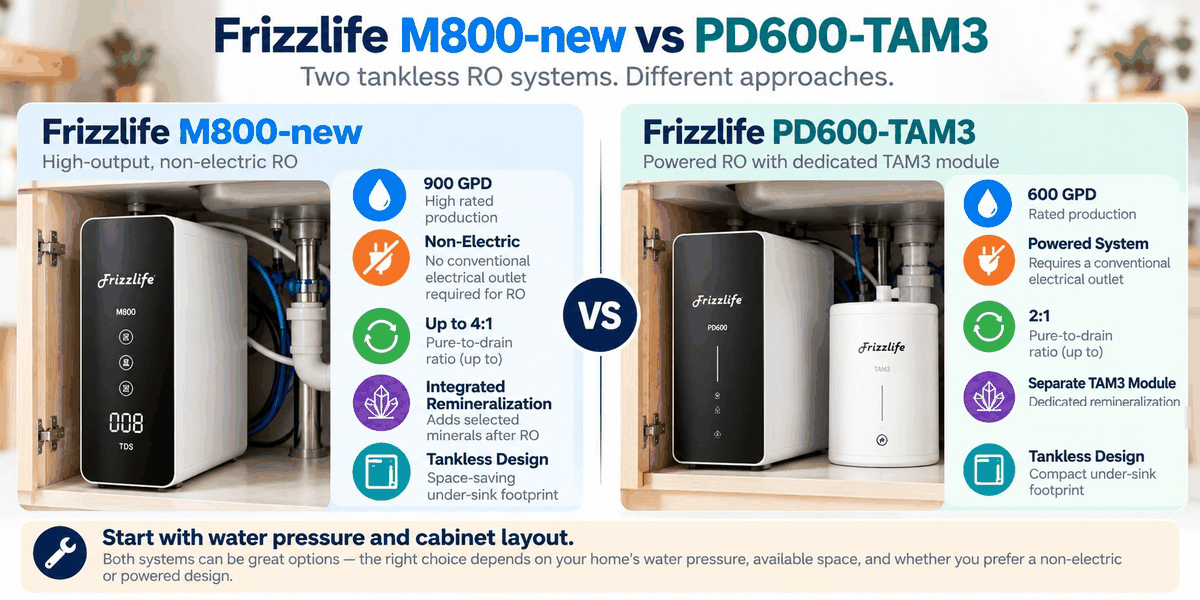
M800 vs PD600-TAM3: Key Differences
Published figures from Frizzlife’s product pages; each difference that changes what you buy gets its own section below. [1] [2]
| Frizzlife M800-new | Frizzlife PD600-TAM3 | |
|---|---|---|
| Type | Tankless under-sink RO | Tankless under-sink RO |
| Rated production | Up to 900 GPD | 600 GPD |
| Electricity for RO production | No conventional connection required | Powered system |
| Pure-to-drain ratio | Up to 4:1 | 2:1 |
| Remineralization | Integrated post-RO route | Separate TAM3 module |
| Main system dimensions* | Approx. 14.9 × 5.5 × 19.7 in | PD600: 5.3 × 14.7 × 15.5 in |
| Additional module | — | TAM3: 5 × 5 × 13.5 in |
| Best fit | High rated output without a nearby outlet | Powered modular RO setup |
*Manufacturer-published dimensions — check current documentation before installation. Product renderings in the illustrations are AI-generated depictions; product appearance and trademarks belong to their respective owners.
Choose the M800-new if You Don’t Want to Depend on an Outlet
The biggest difference: the M800-new relies on household feed-water pressure rather than a conventional electric booster pump for normal RO production. That simplifies installation when there is no convenient outlet, and removes electricity from normal RO production. [1]
But there is a tradeoff: feed-water pressure matters more. The M800 should not be chosen from the 900 GPD number alone — check your plumbing conditions first.
The PD600-TAM3 takes the more conventional powered tankless-RO approach. If your incoming pressure is less favorable or you simply prefer a powered system, that may make it the more suitable route.
M800 Wins on Published Production and Drain Ratio
Frizzlife rates the M800-new at up to 900 GPD, compared with 600 GPD for the PD600-TAM3, and publishes up to 4:1 pure-to-drain against the PD600-TAM3’s 2:1. [1] [2]
On paper the M800 wins both — but neither number is guaranteed performance. Water pressure, temperature, source-water quality and filter condition all move real production and recovery.
So the correct interpretation is: the M800 has the stronger manufacturer-rated specifications — not guaranteed 900 GPD and 4:1 performance in every home.
Remineralization: Same Goal, Different Layout
Both systems add a remineralization step after reverse osmosis; the difference is architectural. The M800-new integrates it into the treatment route; the PD600-TAM3 pairs the PD600 unit with a separate TAM3 remineralization module — a two-component installation.
Neither approach automatically produces “better” water. The practical question: a more integrated M800 installation, or the separate TAM3 module used with the PD600.
And don’t choose on an “8-stage” label — manufacturer-defined stage counts do not map one-to-one onto physical filter housings or functional treatment modules.
Which One Fits Better Under the Sink?
Frizzlife lists the M800-new at approximately 14.9 × 5.5 × 19.7 in; the same site’s comparison material also shows 14.5 × 5.1 × 19.7 in — where two published dimension sets exist, plan for the larger. [2] The PD600 is approximately 5.3 × 14.7 × 15.5 in, plus a separate TAM3 module of about 5 × 5 × 13.5 in.
The M800 is taller; the PD600-TAM3 is two components. Measure around the real obstacles — sink basin, disposal, drain plumbing, shutoff valves, filter-service clearance. M800: watch vertical clearance. PD600-TAM3: allow room for both housings.
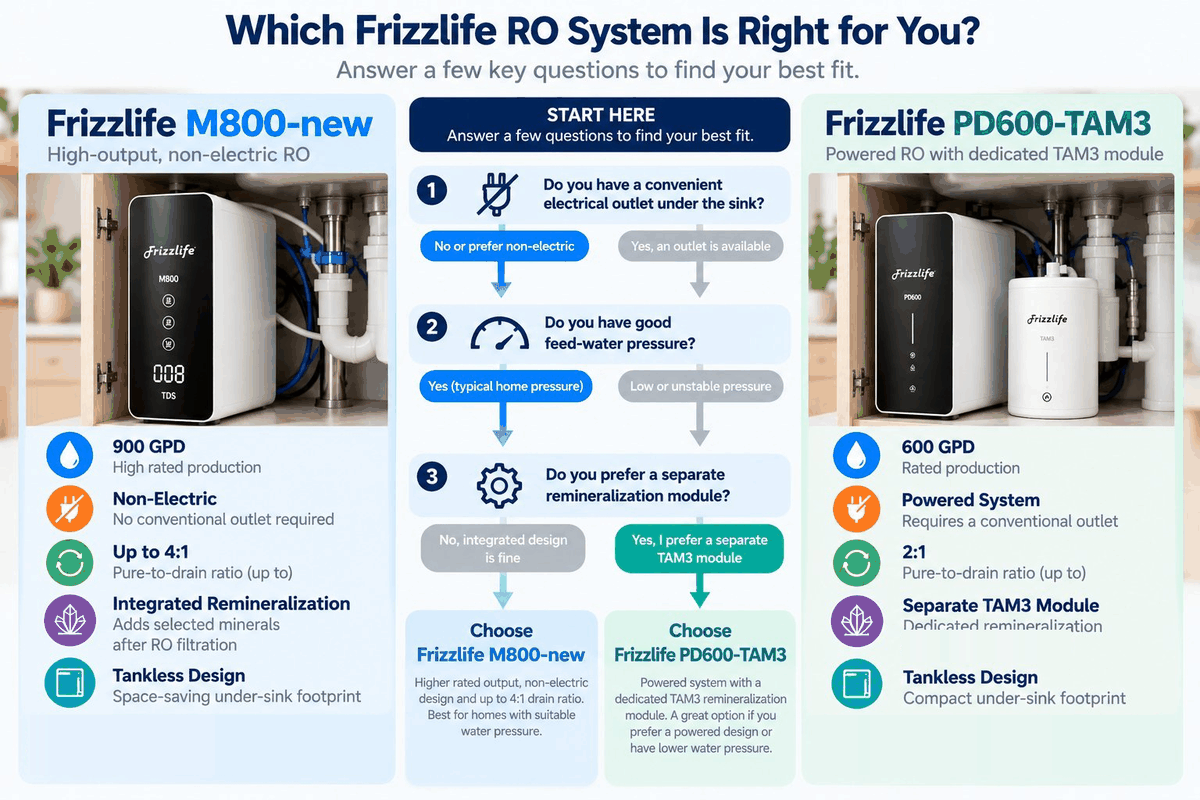
CHOOSE ONE
Which One Should You Buy?
FRIZZLIFE
Frizzlife M800-new
- Your plumbing conditions suit a non-electric design
- Up to 900 GPD of rated production matters
- There is no convenient outlet near the install spot
FRIZZLIFE
Frizzlife PD600-TAM3
- You prefer a powered RO or the separate TAM3 module
- 600 GPD is already sufficient
- Pressure conditions make the M800 less attractive
If neither column matches cleanly, measure pressure and cabinet first. Affiliate links · price and bundle may change.
FINAL DECISION
For a suitable installation, start with the M800-new.
Up to 900 GPD, non-electric RO production and an up-to-4:1 published pure-to-drain ratio give the M800-new the stronger specification package — but it is not automatically the better choice for every home.
The PD600-TAM3 remains the more logical option when you prefer a powered RO platform, want its separate TAM3 remineralization module, or your feed-water conditions are not a good match for the M800. Don’t make this decision from GPD alone: check water pressure and cabinet layout first — then choose the architecture that fits your kitchen.
Frequently asked questions
Is the M800 better than the PD600-TAM3?
On rated production and pure-to-drain, the M800-new leads. The better pick for a specific home depends on feed-water pressure, cabinet space and powered-versus-non-electric preference.
Does the M800 require electricity?
The M800-new is designed to produce RO water using household feed-water pressure rather than a conventional electric booster pump.
Do both systems remineralize RO water?
Yes. Both include post-RO remineralization, but the PD600-TAM3 uses a separate TAM3 module while the M800-new integrates remineralization into its treatment route.
Which system takes up less space?
No simple winner: the M800 is taller, the PD600-TAM3 needs room for two components. Measure your cabinet before ordering.
Research Basis
This comparison is built from current Frizzlife manufacturer documentation for the US versions of both systems. WattPick Lab has not independently laboratory-tested either system, so GPD, pure-to-drain and other figures are published specifications, not our measurements.
Two cautions from that source material: Frizzlife’s pages disagree slightly on the M800’s dimensions — both are quoted, the larger is the planning number; and certification displays differ across M800-series variants, so the series is not merged into one certification conclusion. Verify current specifications and prices before buying.
Both figures are WattPick Lab editorial illustrations built from published specifications — not photographs, not to scale, not test results; product appearance and trademarks belong to their respective owners. See our editorial standards.
Sources
- Frizzlife M800-new US product page — 900 GPD, up-to-4:1, non-electric design.
- Frizzlife PD600-TAM3 US product page — 600 GPD, 2:1, TAM3 module, dimensions.
- NSF: what Standard 58 covers.
- NSF: Standard 372 and component lead content.