Waterdrop C1S Review: Countertop RO Without the Plumbing
Affiliate disclosure: We may earn a commission when you buy through these links, at no additional cost to you. How our links work.
Quick verdict
The C1S suits a kitchen where reverse osmosis is wanted but drilling and plumbing changes are not. Fill its reservoir, plug it in and dispense room-temperature water. Waterdrop lists 75 GPD and a 3:1 pure-to-drain ratio; neither is a promise of continuous tap-like delivery.
Best fit: renters, small kitchens with adequate counter space, or occasional drinking and cooking water. Skip it: if manual refilling is unwelcome, there is no nearby outlet, or you need large continuous demand, hot dispensing or mineralized water from this particular model.
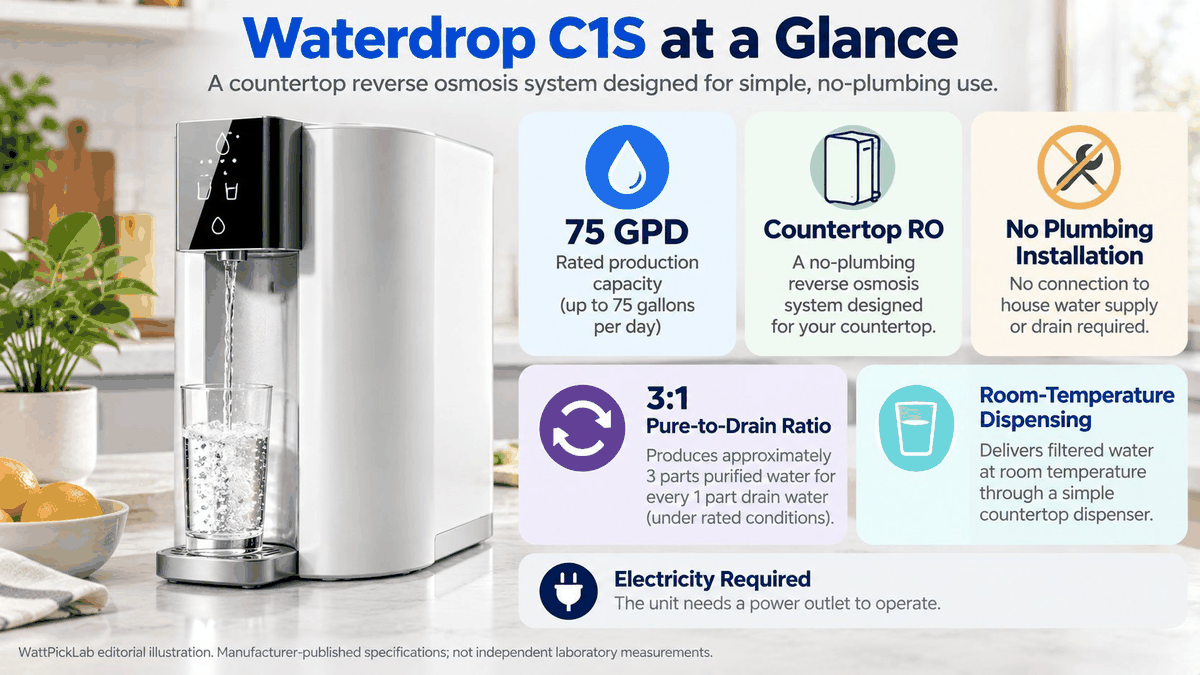
Key specs: what Waterdrop publishes — view the full specification table
| Specification | Published figure | What it actually tells you |
|---|---|---|
| Configuration | Countertop, reservoir-fed | Produces on demand from a fillable tank; no feed-water connection or drain hookup. |
| Rated production | 75 GPD | A rated daily figure at stated conditions, not a measured flow. |
| Pure-to-drain | 3:1 | A rated efficiency figure, not a guaranteed recovery; the drain tank is one you empty. |
| Electricity | Required | The unit plugs into a wall outlet; no power, no production. |
| Dispensing temperature | Room temperature | No hot or chilled function on the C1S itself. |
| Reservoir | Detachable tank | Fills at the sink; Waterdrop markets it as fridge-friendly. |
| Filter | Single C1RF cartridge | Rated for 12 months; twist-out replacement with no tools. |
| Published dimensions | 11.7 × 8.3 × 13.7 in | Plan the footprint including lid clearance and tank removal. |
| Published weight | 14 lb | Light enough to move for cleaning or storage. |
| Best fit | No-plumbing kitchens | The combination, not any single figure, is the selling point. |
GPD = gallons per day. Rated figures are published at manufacturer test conditions, and colder or lower-quality reservoir water reduces real output. WattPick Lab has not independently laboratory-tested these figures.
Check the usable counter space
The published unit is 11.7 × 8.3 × 13.7 in and 14 lb. Add clearance for opening the lid, removing the reservoir, changing the cartridge and placing a glass at the dispenser. An empty counter rectangle is not the whole operating envelope.
A suitable outlet is required; “no installation” refers to plumbing, not electricity. Plan where the reservoir will be filled and reject water emptied. The workflow should be convenient enough to repeat every day.
The routine is the main ownership trade-off
Water passes through pre-filtration, the RO membrane and finishing stages. The separate reject stream collects in the machine’s drain reservoir rather than entering a household drain. Follow the refill and emptying instructions so reject water does not become the next feed supply.
The listed 75 GPD is rated daily production, not measured dispensing speed. For larger households, compare the number of refill cycles you are willing to handle with a plumbed-in alternative. We have not measured batch time, removal performance or taste.
Recovery and the replacement cartridge
Waterdrop’s 3:1 listing means about three parts purified water for one part reject water under suitable conditions. Recovery varies with feed-water quality, temperature and filter condition. It describes the treatment ratio, not a rule that every refill yields the same volume.
The C1S uses one C1RF cartridge with a nominal 12-month interval in the product information used here. Check its current price, availability and replacement instructions before ordering. The actual interval depends on use and water conditions. No-plumbing operation still requires reservoir care and cartridge changes.
C1S, C1H or C1SL?
Use the exact variant’s feature table. The published CoreRO comparison shares the 75 GPD and 3:1 headlines, but dispensing and post-treatment differ. C1S is the straightforward room-temperature route; investigate the listed C1H/C1SL options if hot water or mineral addition is your requirement.
Do not transfer every certification badge or accessory claim across the series. Check the performance documentation for the exact model and contaminant of concern. Stage counts alone do not establish removal performance.
Countertop convenience or a dedicated tap
The G3P800 is a permanent under-sink route with substantially higher rated production. It moves hardware off the counter but requires supply, drain, faucet and power provisions.
Use the RO buying guide to compare other countertop designs. Choose by the refill routine, usable footprint, consumables and exact variant rather than assuming the highest daily production number is the best purchase.
The buying decision
Choose the C1S when the no-plumbing format solves your installation problem and the refill routine fits your usage. If you already have a suitable permanent installation spot and draw water frequently, compare an under-sink system before committing.
Sources & editorial method
This is editorial research, not a laboratory or hands-on review. Specifications are manufacturer claims; runtime and cost examples are labelled planning calculations. Check the exact US model, current documentation and seller configuration before ordering. Product illustrations are editorial artwork, not test photographs.