CAMPING & TRAVEL ELECTRONICS / PRODUCT RESEARCH
BLUETTI Elite 10 Review (2026): Small, Light, and Built for Everyday Electronics
A compact 128Wh battery for laptops, phones and cameras — not for kettles, heaters or hair dryers.
Affiliate disclosure: WattPick Lab may earn a commission from qualifying purchases through affiliate links, at no additional cost to you. Editorial conclusions are independent of commissions. How our links work.
Elite 10
Portable power for small electronics
US 120V model- Nominal energy
- 128 Wh
- Rated AC output
- 200 W
- USB-C output
- 100 W
- Solar input
- 100 W
- Approximate weight
- 3.97 lb
- UPS switching
- ≤10 ms
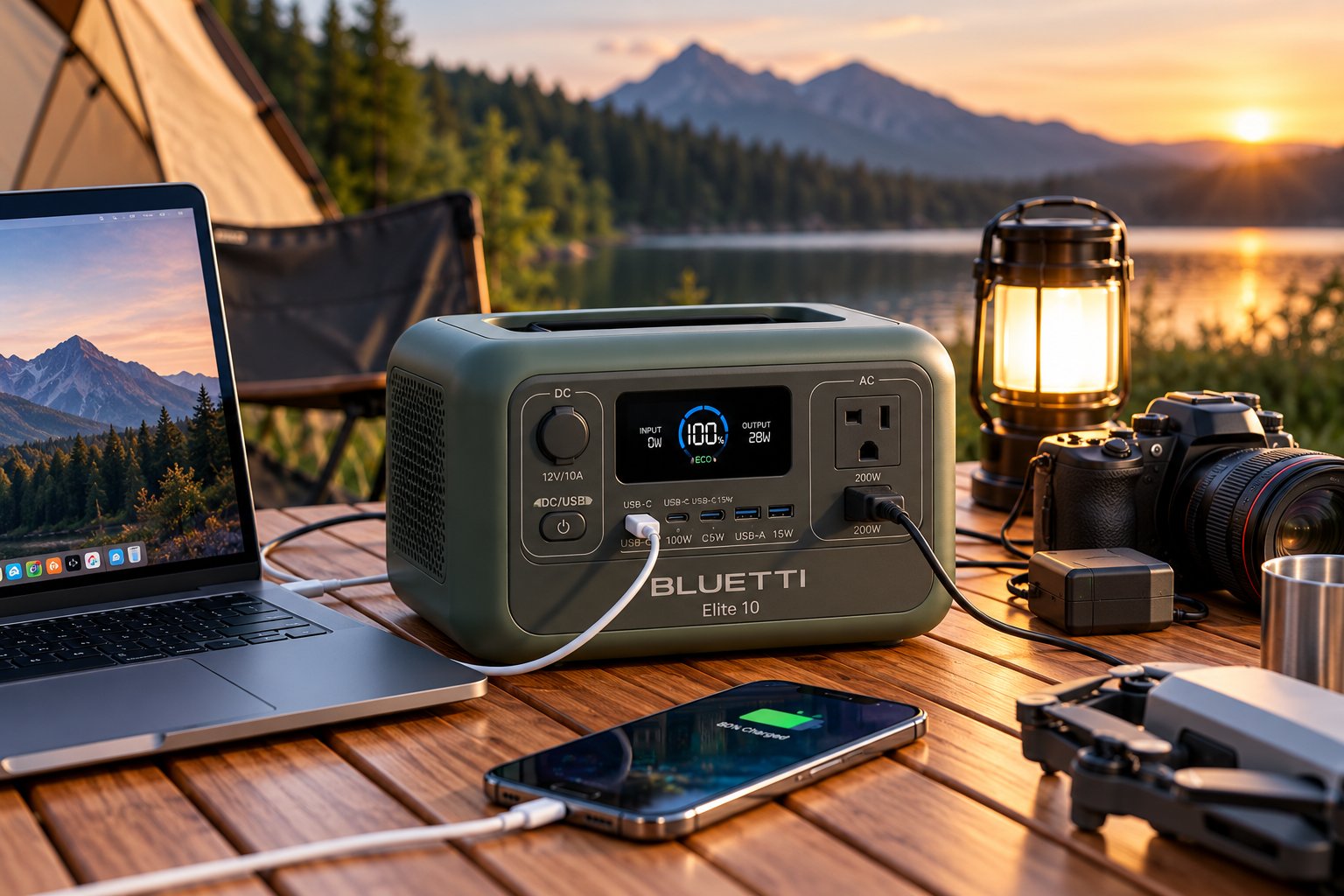
Product appearance and trademarks belong to their respective owners. Figures on this page are WattPick Lab AI-generated editorial illustrations — not photographs, not official renders and not test results. The depicted units are interpretive drawings: rendered branding, port layouts and on-screen values are illustrative and may differ from the actual product.
QUICK VERDICT
Portability matters more than capacity — and that is the trade.
The Elite 10 makes sense if portability matters more than capacity. Its 128Wh battery, 200W AC outlet, 100W USB-C port, LiFePO₄ chemistry and compact 3.97 lb body make it useful for travel, remote work, photography and lightweight camping.
The limits are just as clear: a 128Wh budget and a 200W inverter mean appliances and long runtimes are out of scope. If you need either, the larger Elite 30 V2 is the better fit.
PROS & CONS
BLUETTI Elite 10: pros and cons
Pros
- Only 3.97 lb — genuinely pocketable for a power station
- 100W USB-C charges compatible laptops without the AC brick
- LiFePO₄ battery, rated 3,000+ cycles to 80% capacity
- AC, solar and car charging, with about 70-minute fast AC charging
- ≤10ms UPS support for desk and networking gear
- 3-year warranty
Cons
- Only 128Wh — the smallest budget in its class
- 200W AC output rules out most appliances
- A single AC outlet
- Not waterproof
KEY SPECS
BLUETTI Elite 10 key specifications
| Specification | BLUETTI Elite 10 |
|---|---|
| Capacity | 128Wh |
| AC Output | 200W |
| Surge | 300W |
| USB-C | Up to 100W |
| Solar Input | Up to 100W |
| Battery | LiFePO₄ |
| Cycle Life | 3,000+ to 80% |
| UPS | ≤10ms |
| Weight | 3.97 lb |
| Warranty | 3 years |
Sources: BLUETTI Elite 10 product page ↗ and Elite 30 V2 product page ↗. Manufacturer specifications may change; check the exact regional model before purchase.
THE DECISION THAT MATTERS
What Can 128Wh and 200W Actually Power?
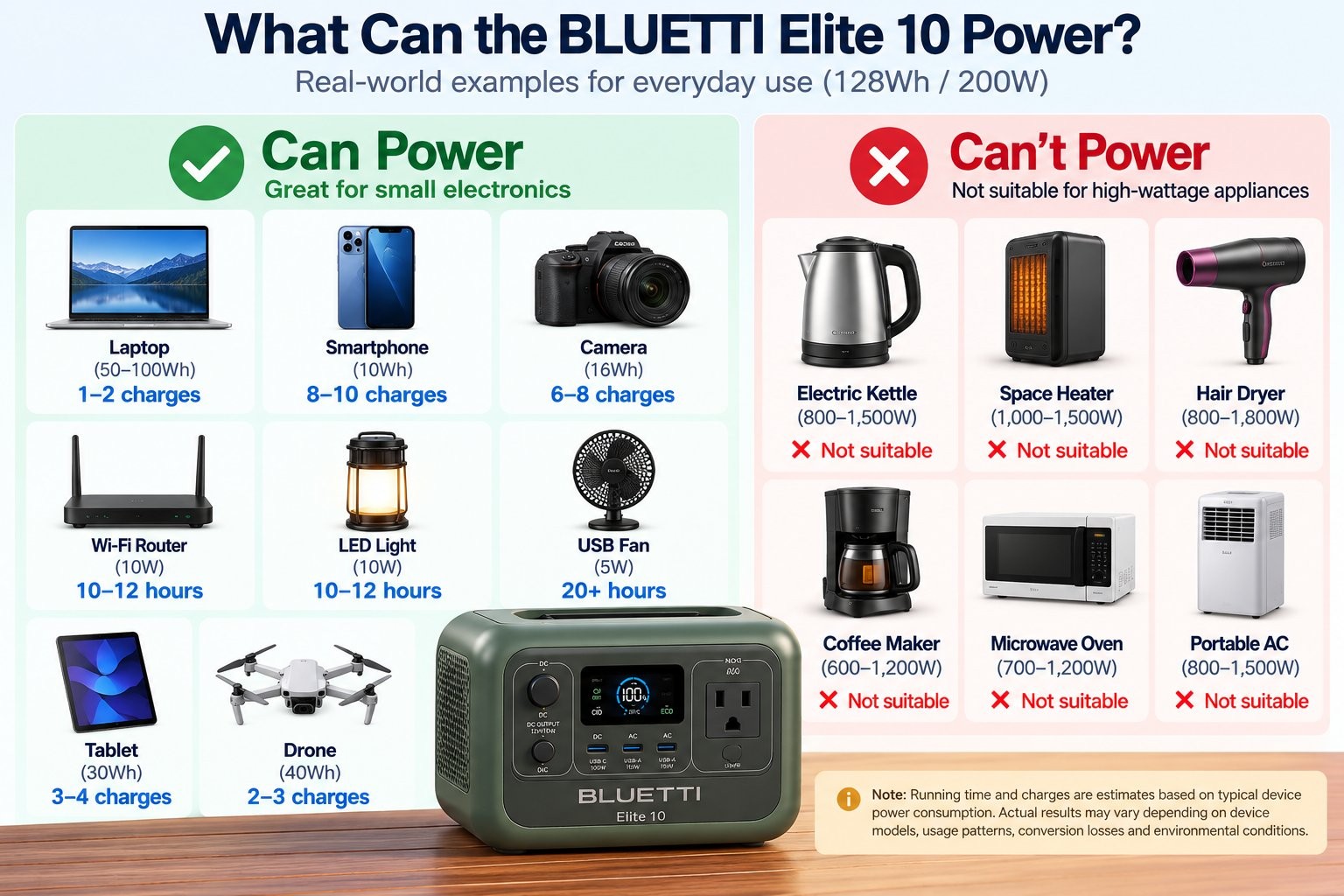
This is the most important question before buying the Elite 10. Its 128Wh battery and 200W inverter are built for small electronics, not for heating.
Well suited to
- Laptops, phones and tablets
- Cameras and battery chargers
- Wi-Fi routers
- LED lights
- Small fans
- Other low-power electronics
Not suitable for
- Electric kettles
- Space heaters
- Hair dryers
- Toasters
- Most coffee makers
- Other high-wattage heating appliances
Actual runtime depends on the device and conversion losses, so we would not rely on exact “hours of runtime” claims. The simplest rule is:
Think electronics, not appliances.
If most of your devices stay comfortably below 200W, the Elite 10 makes sense. If you regularly need more power, move up a size.
CHARGING & PORTS
Charging, Ports, and Everyday Use
One of the Elite 10’s strongest features is its 100W USB-C port, which can charge compatible laptops without a separate AC charger. You also get USB-A, an additional USB-C connection, a DC output and one AC outlet.
BLUETTI supports AC, solar and car charging, with solar input up to 100W. The company lists approximately 70 minutes for fast AC charging under suitable conditions.
The Elite 10 also supports ≤10ms UPS switching, which is useful for low-power desk or networking equipment during short outages.
Its biggest advantage remains physical size. At 3.97 lb, this is a power station you can realistically throw into a vehicle, camera kit or camping setup without feeling like you are carrying a full-size backup battery.
BUYING DECISION
BLUETTI Elite 10 vs Elite 30 V2
If you are choosing between BLUETTI’s smaller models, the decision is straightforward: capacity and output versus weight and price.
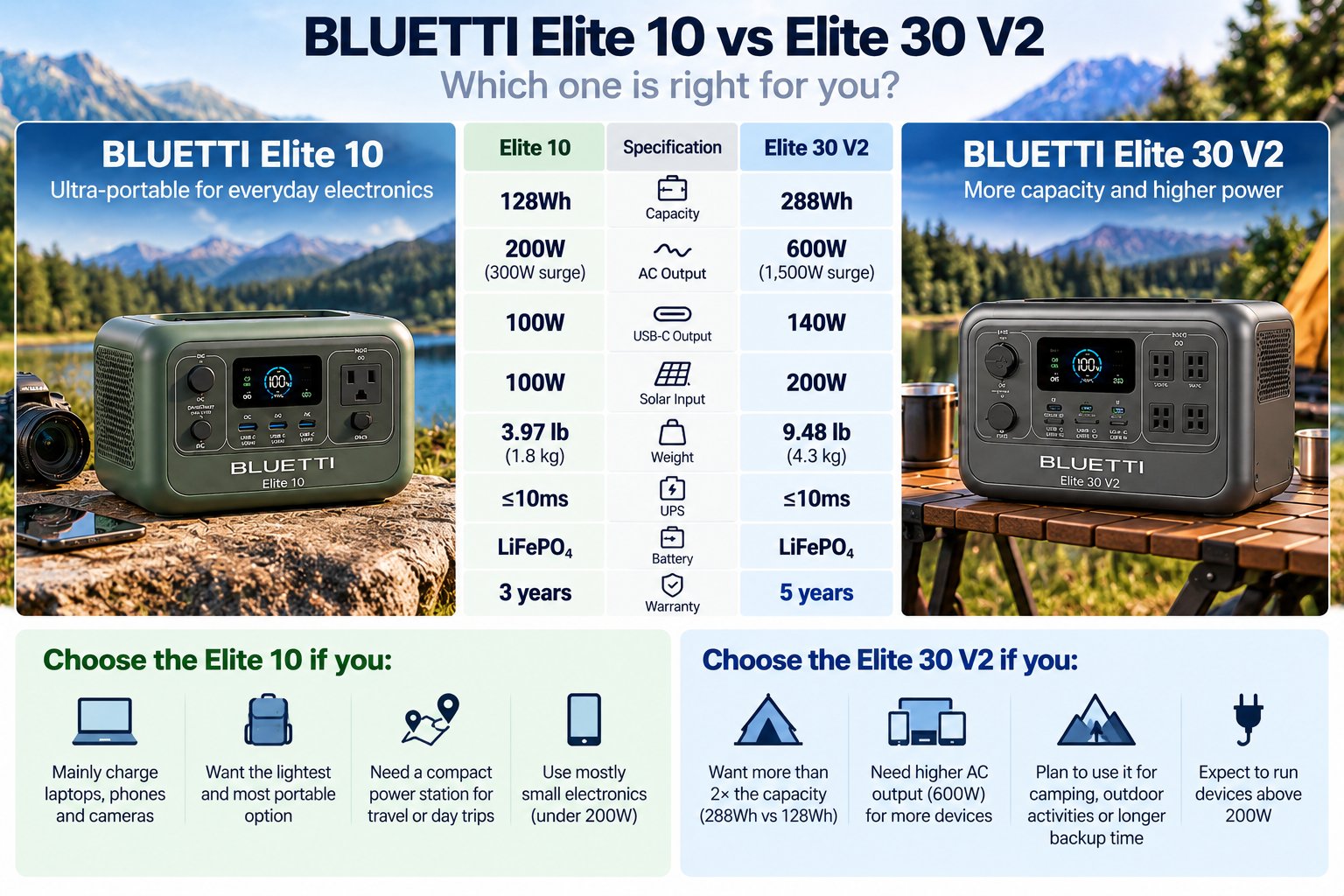
Choose the Elite 10 if you mainly charge electronics and want the lightest option.
Choose the Elite 30 V2 if you want more than twice the capacity and substantially higher AC output.
For many buyers, this comparison is more important than small differences in features.
FINAL VERDICT
Buy the Elite 10 for portability — not maximum power.
The BLUETTI Elite 10 is not trying to replace a 1kWh power station. Its appeal is exactly the opposite: 128Wh of portable power in a 3.97 lb package.
For laptops, phones, cameras, lights and other small electronics, the combination of 100W USB-C, an AC outlet, LiFePO₄ battery, solar charging and compact size makes it a useful travel or lightweight camping companion. If you expect to run high-wattage appliances or need longer backup time, skip it and consider the Elite 30 V2 or a larger power station.
Price tier: Under $200
Prices and promotions change. Check the retailer for the current price before purchasing.