PRODUCT RESEARCH / UNDER-SINK REVERSE OSMOSIS
Frizzlife M800-new Review: 900 GPD RO Without an Electrical Outlet
A tankless system that runs on household water pressure instead of a booster pump. We have not run this unit in a lab — this review is built from Frizzlife’s listings and the specifications it publishes.
Affiliate disclosure: WattPick Lab may earn a commission when you purchase through links on this page, at no additional cost to you. It does not change what we recommend. How our links work.
QUICK VERDICT
A 900 GPD RO system without an electrical outlet.
The Frizzlife M800-new takes an unusual approach to tankless reverse osmosis: it delivers a manufacturer-rated up to 900 GPD without requiring a conventional electrical connection for RO production, with an up-to-4:1 pure-to-drain figure and post-RO remineralization. [1]
The tradeoff is just as unusual: with no booster pump, incoming water pressure carries more of the work. This is not a system to order before checking what is under your sink.
IS THIS THE RIGHT ONE?
Frizzlife M800-new: who it fits, and who it does not
Best for
- You want high rated RO output without a conventional powered system under the sink
- There is no convenient outlet near the installation spot
- Wastewater efficiency matters to you — the up-to-4:1 listing is the strongest published figure in this cluster
- You want remineralization built into the same body rather than a second module
Look elsewhere if
- Your feed-water pressure is weak or inconsistent
- You prefer the PD600-TAM3’s separate remineralization layout
- You need a countertop system with no under-sink installation
- The cabinet cannot take the unit’s height
View Current Frizzlife M800-new Price Affiliate link · check the seller, the bundle and the current price.
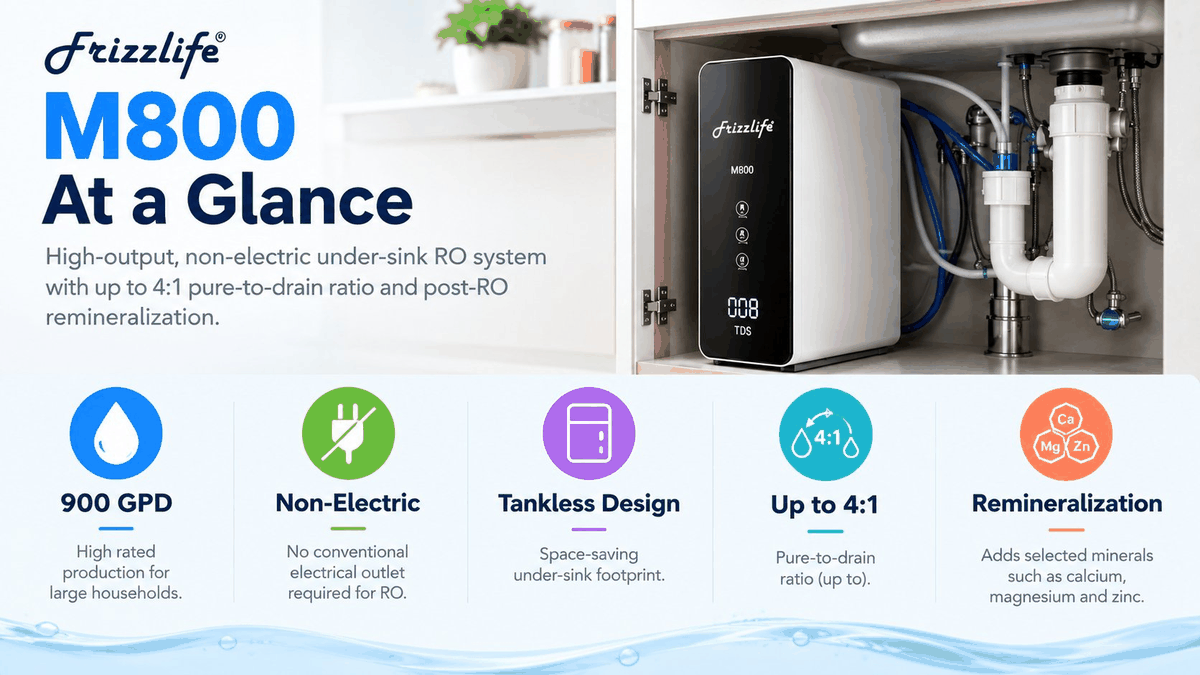
Key specs: what Frizzlife publishes — view the full specification table
| Specification | Published figure | What it actually tells you |
|---|---|---|
| Configuration | Under-sink, tankless | Produces on demand; no pressure tank to place or run dry. |
| Rated production | Up to 900 GPD | A rated daily figure at stated conditions, not a measured flow. |
| Electricity for RO production | No conventional connection required | Feed-water pressure does the work, so pressure matters more. |
| Pure-to-drain | Up to 4:1 | A rated efficiency figure, not a guaranteed recovery. |
| Remineralization | Yes, after RO | Frizzlife names calcium, magnesium and zinc among the added minerals. |
| Monitoring | TDS / filter-life display | Reads after remineralization, so the number includes added minerals. |
| Flush system | Auto flush | Rinse behaviour is handled by the unit, not by a manual routine. |
| Published dimensions | Approx. 14.5 × 5.1 × 19.7 in | Frizzlife’s own pages also show 14.9 × 5.5 × 19.7 in — plan for the larger. |
| Installation | Under-sink | Still needs a feed-water connection and a drain route. |
| Best fit | High output without a nearby outlet | The combination, not any single figure, is the selling point. |
GPD = gallons per day. Rated figures are published at manufacturer test conditions, and cold or low-pressure supply water reduces real output. WattPick Lab has not independently laboratory-tested these figures.
What makes the M800-new different?
The headline feature is not actually the 900 GPD rating. It is how the system produces RO water. [1]
Many high-output tankless systems use an electric booster pump. The M800-new instead relies on household feed-water pressure for normal filtration. That removes one common installation requirement — a nearby electrical outlet — and it means the system can keep producing during a power outage, as long as the household still has sufficient water pressure.
There is another side to that design. A booster pump helps a system hold the pressure RO needs. Without one, your incoming pressure matters more. So before comparing displays or ratios, check water pressure and cabinet clearance first.
900 GPD: useful, but it is not faucet speed
Frizzlife rates the M800-new at up to 900 gallons per day — above the company’s 600 GPD PD600-TAM3 on headline production. [1] [2] But a GPD rating is not a promise about the speed you will see at the faucet.
Actual production moves with incoming pressure, water temperature, feed-water quality, filter condition and installation conditions. The practical takeaway: 900 GPD gives the M800-new substantial rated headroom, and it is not a guarantee that every kitchen sees the same flow — particularly without a booster pump to smooth conditions out.
Filtration and remineralization
The M800-new uses reverse osmosis as the main purification step and adds a remineralization stage after the membrane. Frizzlife describes that stage as adding selected minerals including calcium, magnesium and zinc. [1]
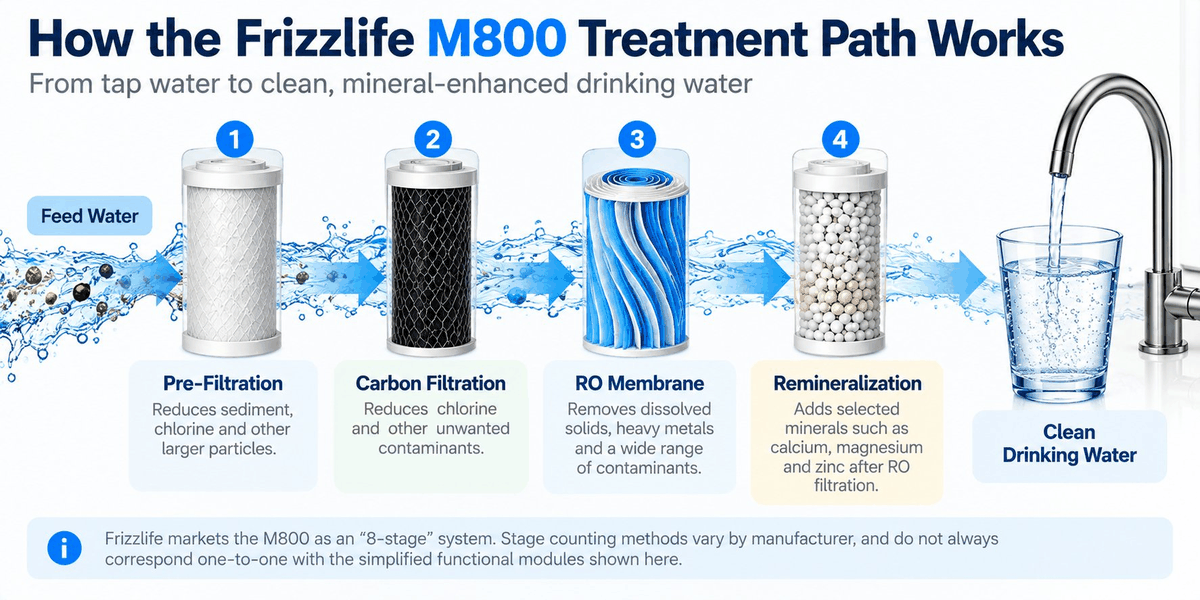
Frizzlife markets the M800-new as an “8-stage” system. Stage counts are a marketing frame: manufacturers count layers, media and functional steps differently. The useful questions are whether it uses RO (yes), whether it remineralizes afterwards (yes), and whether that treatment path matches what you want — not whether the label says seven, eight or nine.
The up-to-4:1 pure-to-drain ratio
Frizzlife publishes a dynamic up to 4:1 pure-to-drain ratio for the M800-new: designed to produce as much as four parts purified water for each part sent to drain under suitable conditions. The PD600-TAM3’s listing is 2:1. [1] [2]
That makes the M800-new the stronger published efficiency specification in this cluster — and “up to” is doing real work in that sentence. Feed pressure, temperature, incoming water quality and membrane condition all move real-world recovery. Read 4:1 as a strong rated figure, not a guaranteed result for every installation.
Installation: check these two things first
Frizzlife’s product information lists the M800-new at approximately 14.5 × 5.1 × 19.7 in (L × W × H); the same site’s comparison table shows 14.9 × 5.5 × 19.7 in. The narrow body helps with cabinet depth, but the height is worth checking carefully — and where two figures exist, plan for the larger. [1]
- Usable cabinet height. Do not measure only the empty cabinet. Account for the sink basin, disposal, pipes and anything that obstructs cartridge access.
- Incoming water pressure. The M800-new relies on feed-water pressure rather than a conventional electric booster pump, so this is the parameter the whole design leans on.
You also still need normal under-sink RO plumbing: a feed-water connection and a drain route. “Non-electric” does not mean “no installation.”
M800-new vs PD600-TAM3: which Frizzlife route makes more sense?
These two systems overlap enough that this is the most useful comparison on the page.
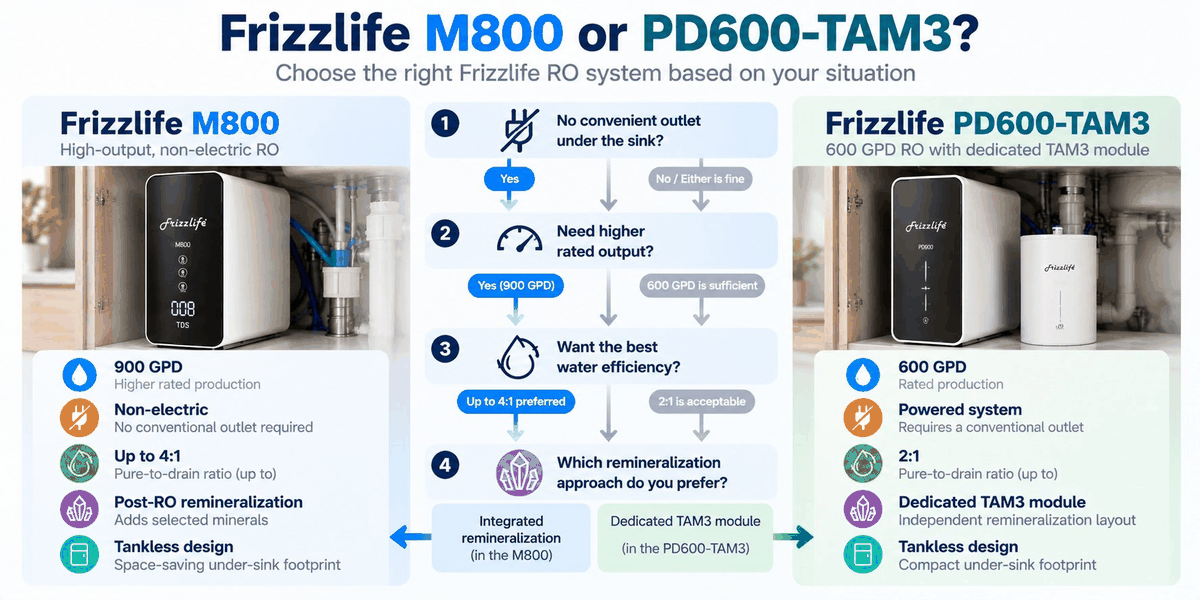
FRIZZLIFE M800-NEW
Output without an outlet
- Up to 900 GPD rated production.
- No conventional electrical connection for RO production.
- Up to 4:1 published pure-to-drain ratio.
- Integrated remineralization in the same body.
- A relatively narrow system body.
FRIZZLIFE PD600-TAM3
The established two-part layout
- 600 GPD rated production.
- A dedicated separate TAM3 remineralization module.
- A clearly defined two-component treatment layout.
- 600 GPD being sufficient for your household.
The M800-new looks stronger on several headline specifications. That does not automatically make it the better installation. The deciding question is whether your water pressure and cabinet layout suit a non-electric design — if they do not, the PD600-TAM3’s pumped, modular route is the safer one. Read the PD600-TAM3 review →
Who should buy the Frizzlife M800-new?
The M800-new makes the most sense if you already know you want under-sink RO and specifically value high rated production without a conventional powered tankless unit. It is particularly compelling when there is no convenient outlet under the sink, 900 GPD of rated headroom is genuinely useful for how you draw water, wastewater efficiency matters, and your incoming pressure checks out.
Look elsewhere if your plumbing pressure is questionable, the unit’s height does not fit the cabinet, or you want a countertop system with no under-sink installation at all — the full reverse osmosis comparison covers that route.
FINAL VERDICT
Measure the cabinet and verify the pressure first.
The M800-new stands out less for its marketing stage count and more for its underlying design: up to 900 GPD, non-electric RO production, tankless construction, an up-to-4:1 pure-to-drain figure and post-RO remineralization in one body. [1]
That combination is genuinely unusual at this class, and for kitchens without a convenient outlet it may be the most practical route on our shortlist. The main check before buying is straightforward: measure the cabinet and verify your water pressure first. If both work for the M800-new, it deserves the slot.
Frequently asked questions
Does the Frizzlife M800-new require electricity?
The M800-new is designed to use household feed-water pressure rather than a conventional electric booster pump for RO production. This makes incoming water pressure particularly important, and it removes the outlet requirement many tankless systems have.
Does the M800-new remineralize the water?
Yes. It includes a post-RO remineralization stage, and Frizzlife states that selected minerals including calcium, magnesium and zinc are added after reverse osmosis.
Is 900 GPD the same as actual faucet flow?
No. GPD is a rated daily-production specification. Actual output depends on operating conditions including feed pressure, temperature, source-water quality and filter condition.
Is the 4:1 pure-to-drain ratio guaranteed?
No. Frizzlife describes the figure as up to 4:1. Real-world recovery can vary with feed pressure, temperature, incoming water quality and membrane condition.
Research basis
This review covers the Frizzlife M800-new rather than treating every M800-series variant as identical. It is built from documents, not from a unit in our hands: we have not installed, tested, measured or tasted this system, and nothing here is a laboratory result.
What we used: Frizzlife’s current US product page for the M800-new and the M800-series comparison material on the same site. Two cautions come straight from that source material. First, Frizzlife’s own pages disagree slightly on dimensions — the pre-purchase listing shows about 14.5 × 5.1 × 19.7 in while its comparison table shows 14.9 × 5.5 × 19.7 in — so this page quotes the pre-purchase figures, flags the conflict and plans for the larger. Second, certification displays differ across M800-series variants, so we do not merge the series into one certification conclusion; check the sheet for the specific variant you are buying. Specifications and prices move, so verify before you buy; we do not assign a star rating from specifications alone.
Three figures accompany this page — the at-a-glance summary, the treatment path and the decision map. All are WattPick Lab editorial illustrations built from published manufacturer specifications; they are not photographs, not to scale and not test results, the product renderings are AI-generated, and product appearance and trademarks belong to their respective owners. See our evidence and editorial standards.