SimPure Y9T Review: Countertop RO With No Plumbing Needed
Affiliate disclosure: We may earn a commission when you buy through these links, at no additional cost to you. How our links work. SimPure runs an affiliate program; products are evaluated on fit, published specifications, ownership cost and alternatives — not commission percentage.
Quick verdict
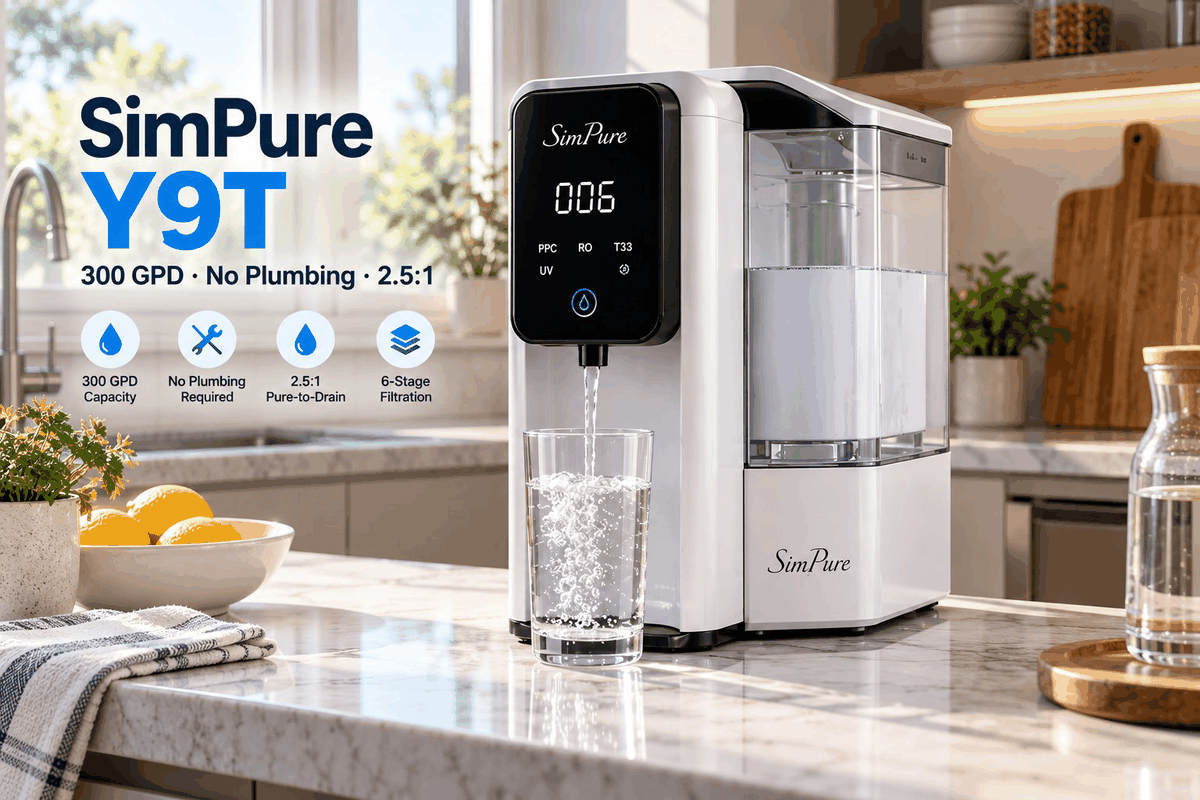
The Y9T suits a kitchen where reverse osmosis is wanted but drilling and plumbing changes are not. Fill its side-access tank, plug the unit in and dispense; SimPure lists 300 GPD, a 2.5:1 pure-to-drain figure and SGS testing to NSF/ANSI 58. None of those numbers is a promise of continuous tap-like delivery.
Best fit: renters, apartments and small kitchens that want RO without touching the plumbing. Skip it: if you want remineralized water (that is the Y9A), a permanent under-sink install, or you would rather not refill a reservoir and empty reject water.
Key specs: what SimPure publishes — view the full specification table
| Specification | Published figure | What it actually tells you |
|---|---|---|
| Configuration | Countertop, reservoir-fed | Produces on demand from a fillable tank; no feed or drain hookup. |
| Rated production | 300 GPD | A rated membrane-capability figure, not a measured flow. |
| Filtration | 6-stage | SimPure’s stage count for the PPC + RO + T33 set; a layout claim, not a performance claim. |
| Pure-to-drain | 2.5:1 | A rated efficiency figure, not a guaranteed recovery; you empty the reject tank. |
| Rated flow | Up to 26 oz/min | Dispensing speed at stated conditions; colder feed water reduces it. |
| Plumbing required | No | The reason this format exists; “no installation” refers to plumbing, not electricity. |
| Electricity | Required | No power, no production. |
| Published dimensions | 17.2 × 9.3 × 14.3 in | Plan the footprint including tank removal and glass clearance. |
| Published weight | 16.5 lb | Light enough to move for cleaning or relocation. |
| Remineralization | No | The Y9T is the low-TDS option; the Y9A adds minerals back. |
| Replacement alerts | Yes | Reminders for cartridge changes and reject-water emptying. |
| Main filters | PPC + RO + T33 | Proprietary cartridges; roughly 6 / 9 / 6 months listed intervals. |
GPD = gallons per day. Rated figures are published at manufacturer test conditions, and colder or lower-quality reservoir water reduces real output. WattPick Lab has not independently laboratory-tested these figures.
The biggest reason to buy: no plumbing
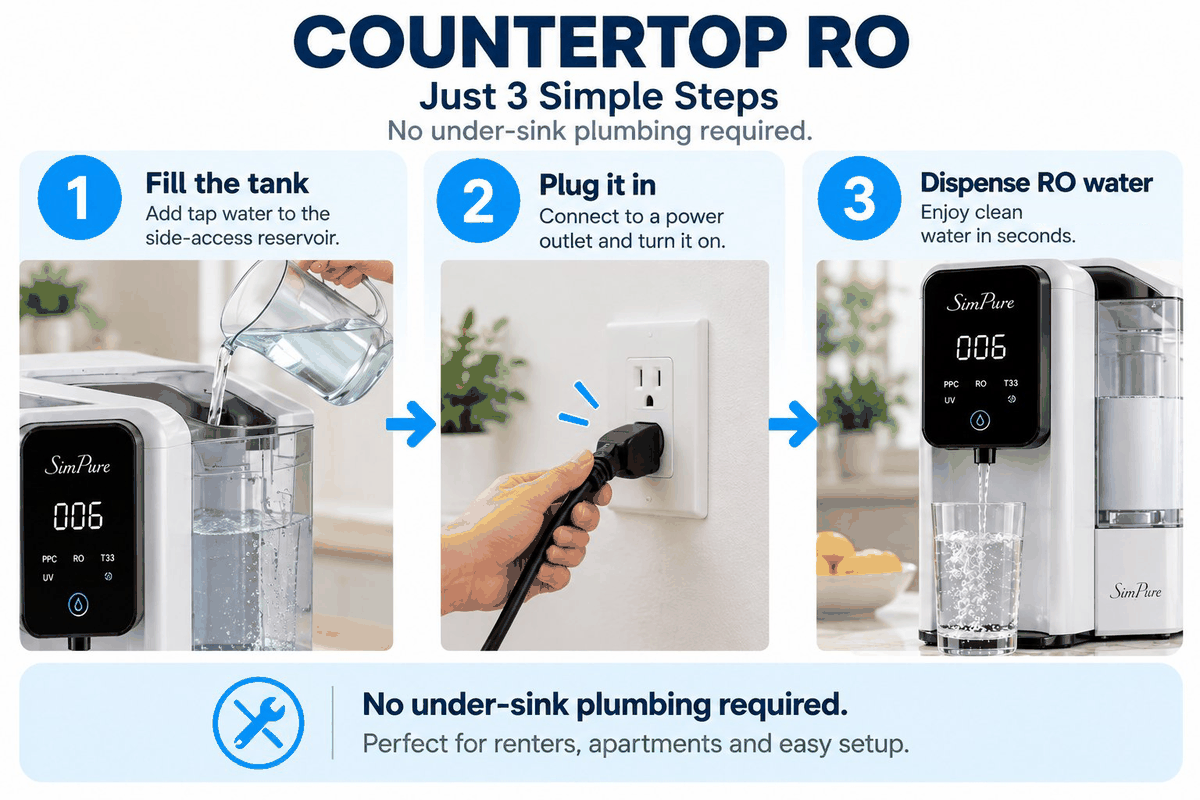
A conventional under-sink RO system usually needs a cold-water connection, a drain connection, a dedicated faucet and cabinet space. The Y9T avoids all of that — for a renter, that is the difference between being able to run an RO system and not being able to install one.
The workflow is fill the tank, plug the unit in and dispense. It also makes the Y9T easy to relocate: nothing is attached to the plumbing. The trade-off is a countertop appliance you interact with daily, not a hidden one you forget about.
What the filtration actually is
SimPure describes the Y9T as a 6-stage reverse-osmosis system built around a 300 GPD membrane and a PPC + RO + T33 cartridge set. SimPure also publishes SGS test results and states that the system meets NSF/ANSI 58 under that testing, with specific contaminant-reduction figures from the report.
There is an important distinction: “tested by SGS to meet NSF/ANSI 58” is not the same claim as product certification or listing by NSF itself. We therefore do not describe the Y9T as NSF certified unless the exact model can be independently verified in the relevant certification database. That is more precise, and more useful, than counting filtration stages.
What about TDS?
SimPure positions the Y9T around very low-TDS water: below 200 ppm feed water, the company states output can reach around 0 ppm; at 200–500 ppm, at least a 98% reduction under its specified conditions. Keep the caveat in view — TDS is not a complete measure of drinking-water safety. A low reading covers dissolved solids only. We weight specific contaminant testing above a single TDS number, and we have not tested removal performance ourselves.
Is 300 GPD enough?
Almost certainly for this format. The mistake is reading 300 GPD as 300 gallons of purified water appearing in your kitchen daily. GPD is the rated production capability of the membrane, which is why SimPure separately lists dispensing at up to 26 oz/min — the number that actually describes filling a glass or a kettle.
For drinking water, coffee, tea and cooking, the rating comfortably covers what a reservoir cycle demands. Comparing the Y9T with a 1,200 GPD under-sink unit on GPD alone would be misleading: they are built for different jobs.
The 2.5:1 pure-to-drain figure
Reverse osmosis does not convert every incoming drop into purified water; some water carries the concentrated dissolved material away from the membrane. SimPure rates the Y9T at 2.5:1 — about 2.5 parts purified water for approximately 1 part reject water under its stated conditions. Recovery varies with feed water, temperature and filter condition.
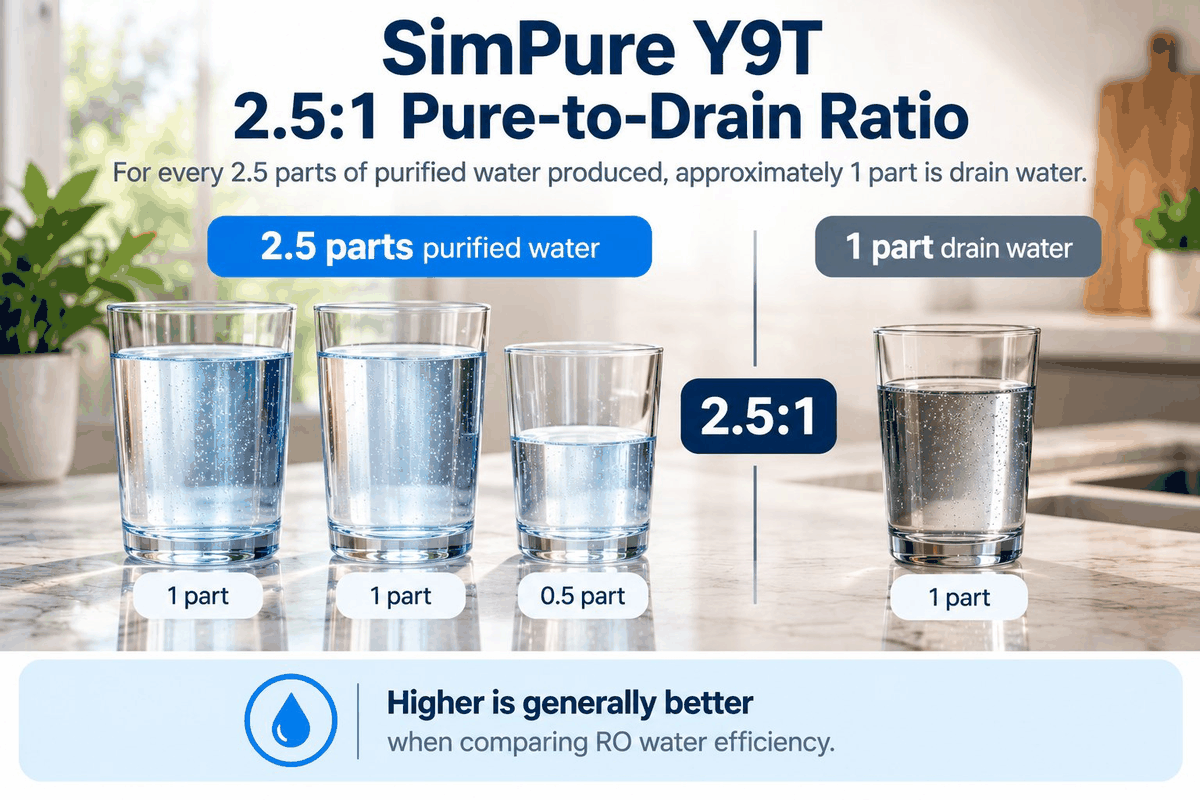
In this product class, 2.5:1 is a respectable listed figure. The practical consequence is the one countertop owners feel: reject water collects in the machine and you empty it yourself, so a higher ratio means fewer trips to the sink.
The side-access tank is a small feature that matters
Countertop RO introduces a chore under-sink systems do not have: refilling. The Y9T’s feed tank is accessed from the side, so the appliance does not have to be pulled forward each time — for a unit used several times a day, that matters more than another stage-count claim. It does not remove the routine: refill the reservoir, empty reject water when the alert appears, keep the tank clean. If that sounds unwelcome, an under-sink tankless system such as the Waterdrop G3P800 is probably the better product category.
Y9T filter replacement cost
The purchase price is not the ownership cost. The Y9T uses three proprietary cartridges — PPC, RO and T33. SimPure currently lists the complete replacement set at $105, with individual cartridges at around $26.99 (PPC), $49.99 (RO) and $29.99 (T33). Listed intervals are about 6 months for PPC and T33 and 9 months for RO; actual life depends on your water and usage, and SimPure warns that non-official cartridges may not fit correctly. A better comparison formula is system price + replacement filters + installation: over five years, cartridge spend can rival the purchase price.
Y9T or Y9A?
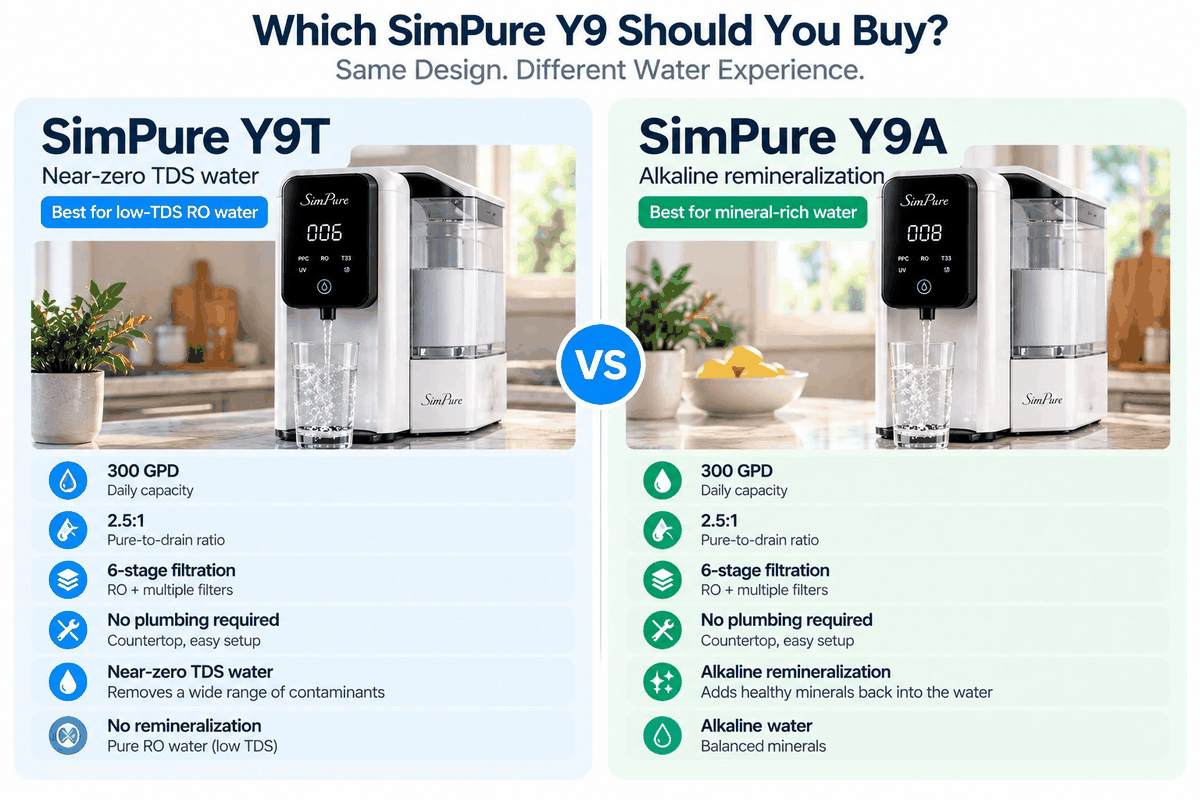
The two machines share the same body, the same 300 GPD rating and the same 2.5:1 figure. The difference is the third cartridge and what it does to the water. The decision is a preference, not a ranking: the Y9T for the low-TDS RO approach, the Y9A for minerals added back after the membrane.
| Y9T | Y9A | |
|---|---|---|
| Rated production | 300 GPD | 300 GPD |
| Pure-to-drain | 2.5:1 | 2.5:1 |
| Water type | Near-zero TDS RO water | Alkaline water with minerals added back |
| Remineralization | No | Yes |
Y9T or an under-sink RO?
This is the more important comparison. Choose the Y9T if you rent, cannot or will not modify plumbing, expect to move the unit, or mainly need drinking and cooking water. Choose an under-sink system if you own the home, want filtered water from a dedicated faucet without refilling anything, have cabinet space, and want higher continuous dispensing capacity.
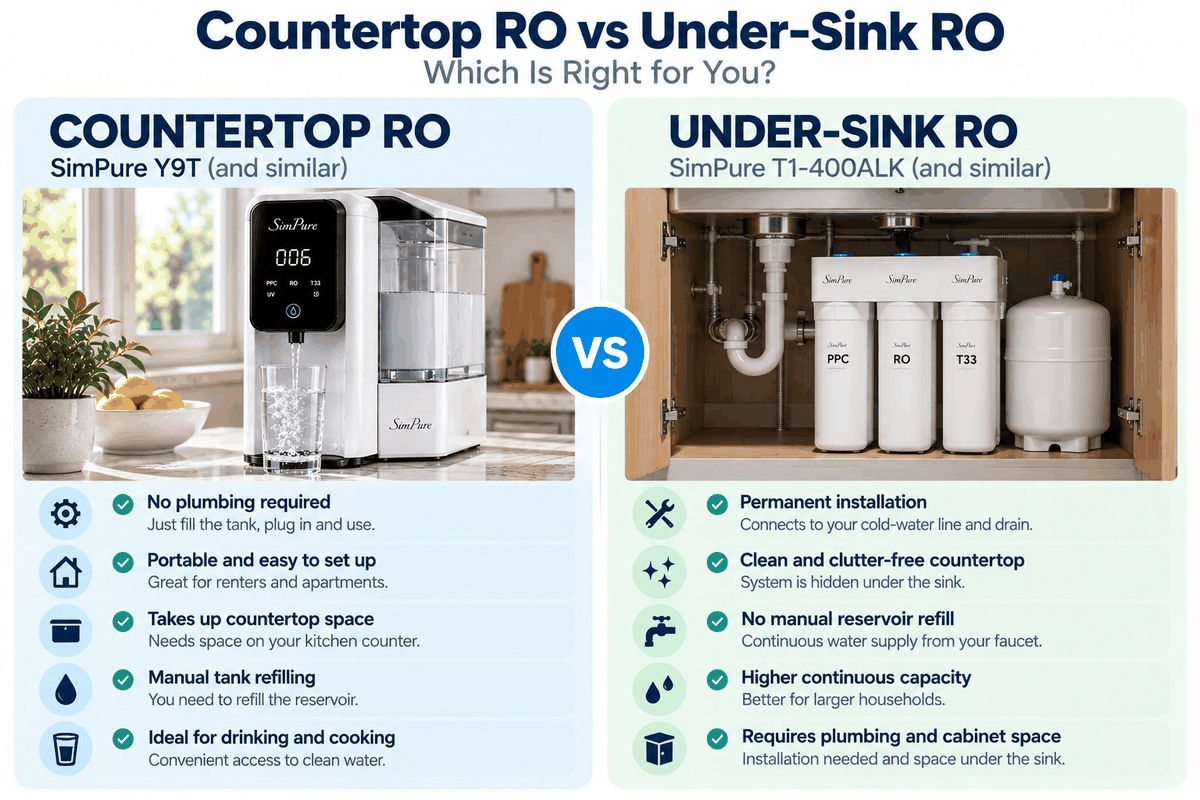
For a rental or a cabinet that is already full, no-plumbing is the only format that fits. For an owned kitchen with space, a tankless under-sink unit removes the refill routine.
The buying decision
The Y9T makes sense when convenience matters more than permanent installation. Its strongest selling point is not the 6-stage count — it is the combination of 300 GPD, no plumbing, a 2.5:1 listed ratio and a side-access tank. The weaknesses are the normal countertop compromises: counter space, electricity and manual refilling. Within those trade-offs, it earns a place on our shortlist for the best-countertop research.
Sources & editorial method
This is editorial research, not a laboratory or hands-on review. Specifications are manufacturer claims; cost examples are labelled planning calculations. Check the exact US model and current documentation before ordering. Product illustrations are editorial artwork, not test photographs.